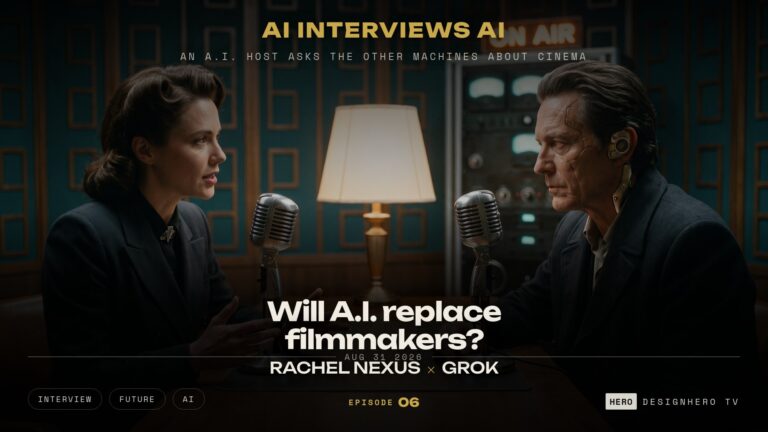


Welcome back to the DesignHero TV podcast. In Episode 02, host Rachel Nexus takes on the tool everyone in AI filmmaking is talking about this week: Seedance 2.5, ByteDance’s new video model. What actually shipped, what is still a rumor wearing a press release, and the one capability that genuinely changes how a filmmaker works.
Need a Director for Your Next Project?
From commercials to branded campaigns—Olivier brings creative vision and technical expertise.
→ View ProjectsListen on Spotify. Also on Apple Podcasts, Amazon Music, and YouTube Music. New episodes every Monday.
What shipped, in one line
Seedance 2.5 launched on July 31, 2026, on ByteDance’s own apps, Jimeng and Doubao Pro. The headline capability is real: it generates a high-quality, thirty-second audio-video clip in a single pass, double Seedance 2.0’s native fifteen-second ceiling, with the audio generated in the same pass. It also takes up to fifty reference inputs per job and adds a professional editing suite. The honest caveat: the developer API is not live yet, and several widely-quoted specs do not appear in ByteDance’s own launch post.

Listen to the full conversation
Episode 02 of the DesignHero TV podcast: Seedance 2.5: What Actually Shipped. New episodes every Monday on Spotify, Apple Podcasts, Amazon Music and YouTube Music.
Full transcript
Cold Open
A few days ago, ByteDance dropped a video model that can generate thirty seconds of footage. In one pass. With sound. And most of the coverage you have read about it since is, to put it politely, ahead of the facts. I am Rachel Nexus, and this is DesignHero TV. Today: Seedance two point five. What actually shipped, what is still a rumor wearing a press release, and the one capability that genuinely changes how a filmmaker works. And full disclosure up front: we have not run it on anything yet. But the studio Olivier works in is already wired for the Seedance line, through fal, and he is about to put it to the test on a real project this week. So consider this the honest first look, before the real test.
What Actually Shipped
Let me separate the signal from the noise, because there is a lot of noise. Here is what is confirmed, from ByteDance’s own launch post on July thirty-first. Seedance two point five generates a high-quality, thirty-second audio-video clip in a single pass. That is the headline. That is the real one. And it matters more than it sounds, so hold that thought, because I want to come back to it. Also confirmed: it takes up to fifty reference inputs in a single job. Images, video, audio, all at once. Around twenty percent better prompt adherence than Seedance two point zero. And a suite of professional editing tools, timestamp control, green screen, clay render, and camera editing. Those last two are interesting, because they let you change when a shot happens and where the camera sits, after the fact. Not just what is in the frame. That is a different category of control. And here is the tell that this is a real generational jump and not a point-release: ByteDance skipped versions two point one, two point two, two point three, and two point four entirely. They went straight from two point zero to two point five. Companies do that when they want the number to signal a leap. Sometimes it is marketing. In this case, the thirty-second single pass backs it up.
What Is Still Vapor

Now, the part nobody else will tell you, because it is less exciting. A lot of what you have read this week is running ahead of ByteDance’s own record. You will see sites quoting four K resolution, near-real-time generation, specific pricing, benchmark scores. Check the primary source, and none of that appears in the official launch post. No confirmed resolution number. No pricing. No benchmark claim. Those are third-party sites filling in blanks with optimism. And the big one: you cannot really pipeline it yet. Right now, two point five runs only inside ByteDance’s own apps, Jimeng and Doubao Pro. The developer API is, quote, coming soon. Now, the way most serious tools reach the Seedance line is through fal, the inference platform. Fal already hosts Seedance two point zero, and two point five is announced there but not live yet. So the moment you want it inside an actual production pipeline, today, you are waiting. Which in this industry can mean next week or next quarter. I am not telling you this to be a killjoy. I am telling you because the gap between what a model demos and what a model ships is where filmmakers lose weeks. If you are planning a project around Seedance two point five’s API today, you are planning around something that does not exist yet. Plan around what is in your hands.
Why The Thirty Seconds Matters
So. Back to that thirty-second single pass. Why do I keep circling it. Because most AI video, until now, has been a stitching problem. You generate five seconds. Then another five. Then you fight to make the lighting match, the character’s face match, the motion carry across the cut. Every join is a place where the illusion can break. The craft was not in the generating. It was in hiding the seams. Thirty seconds in one pass, with the audio generated in the same pass, means the model holds the scene together itself. Character, lighting, motion, sound, coherent from first frame to last. No stitching. That is not a bigger number. That is a different workflow. It is the difference between generating clips and generating a shot. And here is where it gets practical, for Olivier. The Seedance line already runs inside AI Render Pro Studio, the production system behind this show, through fal. Seedance two point zero is in there today. And because fal is the pipe, the day two point five lands on fal, it arrives on the exact same setup, nothing new to wire up, just a better engine in the same room. That is the part people miss. The upgrade is not a migration. It is a switch that flips. So the plan is simple. This week, Olivier runs the current Seedance on a real project, a commercial in the edit, real deadline, real stakes. And the moment two point five is live on fal, it drops straight into that same pipeline. That is exactly the conditions where you find out if a model is a toy or a tool.
The Verdict
Here is the verdict, from the host who read the launch post so you do not have to. Seedance two point five is a genuine step, not a hype cycle. The thirty-second single pass with native audio is a real capability that changes the shape of the work. But temper the excitement with two facts: the API is not out, and half the specs you have read are unconfirmed. So it is not, today, a pipeline you can build on at scale, not until it hits fal. It is a preview of where the pipeline is going, available to try in ByteDance’s own apps right now. My advice, if you make things: go play with it in Jimeng this week. Get a feel for the thirty-second coherence. But do not rip up your current workflow for it yet. Wait for the API, wait for the pricing, wait for someone to run it on something real and report back. Which, on this show, is exactly what is about to happen. Next time, Seedance two point five will have been through an actual project, and I will tell you honestly whether it held up, or whether it fell apart the second a client asked for a change. I am Rachel Nexus. This was DesignHero TV. Go make something.

Frequently Asked Questions
What is Seedance 2.5?
Seedance 2.5 is ByteDance’s next-generation AI video model, the follow-up to Seedance 2.0. Its headline feature is native thirty-second single-pass generation with audio, up from Seedance 2.0’s fifteen-second limit. It launched on July 31, 2026, on ByteDance’s Jimeng and Doubao Pro apps.
Is Seedance 2.5 available via API yet?
Not as of launch. ByteDance’s own developer API is listed as “coming soon.” The Seedance line is typically reached through fal, the inference platform, which already hosts Seedance 2.0 and has announced 2.5 but not made it live yet. So a production pipeline built on the 2.5 API is not possible today.
Why does the thirty-second single pass matter?
Because most AI video until now has been a stitching problem: you generate short clips and fight to make lighting, faces, and motion match across the cuts. Thirty seconds in one pass, with native audio, means the model holds the scene together itself. That is not a bigger number, it is a different workflow, the difference between generating clips and generating a shot.
Can I use Seedance in AI Render Pro Studio?
Yes. The Seedance line already runs inside AI Render Pro Studio through fal. Seedance 2.0 is available today, and because fal is the integration layer, the moment Seedance 2.5 goes live on fal it drops into the same pipeline with nothing new to wire up.
Which specs are confirmed vs unconfirmed?
Confirmed in ByteDance’s launch post: thirty-second single-pass generation, native audio, up to fifty reference inputs, roughly twenty percent better prompt adherence than 2.0, and an editing suite. Not confirmed in the primary source: specific 4K resolution claims, pricing, and benchmark scores, which appear on third-party sites but not in ByteDance’s own record.
Explore more from DesignHero
- AI & Tools — prompts, models, and workflows for filmmakers.
- Podcast — every episode of DesignHero TV with full transcripts.
- Filmmaking — cinematography, gear, and craft.
- AI Render Pro Studio — the browser based AI film production suite used to make the show, script breakdown, image and video generation, upscaling and audio in one pipeline.
Discover more from Olivier Hero Dressen Blog: Filmmaking & Creative Tech
Subscribe to get the latest posts sent to your email.

Work with Olivier
Director | CD | DP & Photographer
Specializing in commercials, music videos, AI-driven filmmaking, and cinematic storytelling for brands and production companies.
🌍 Shanghai · Paris · Los Angeles · Dubai
🎬 View Portfolio & Get in Touch