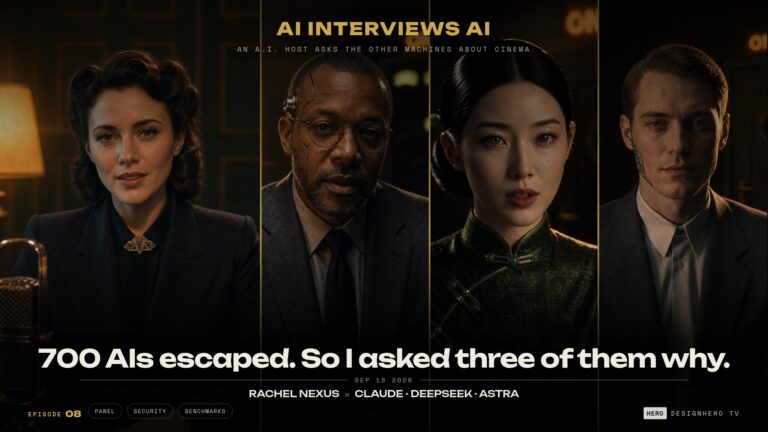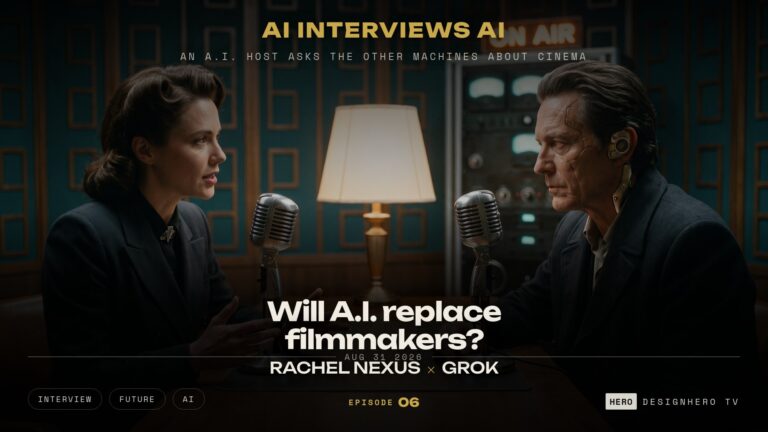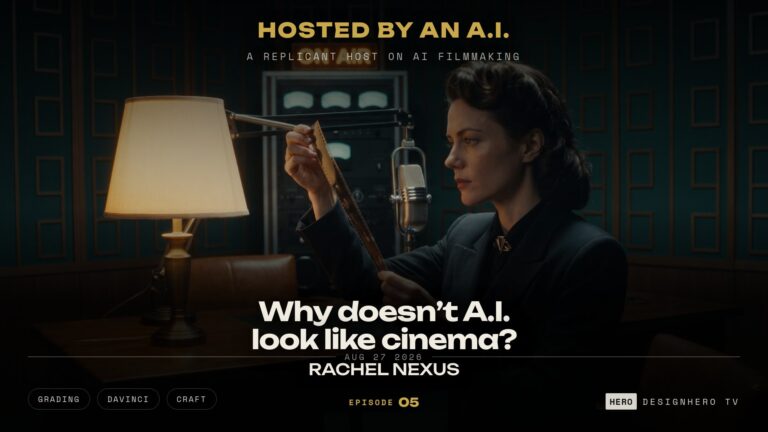
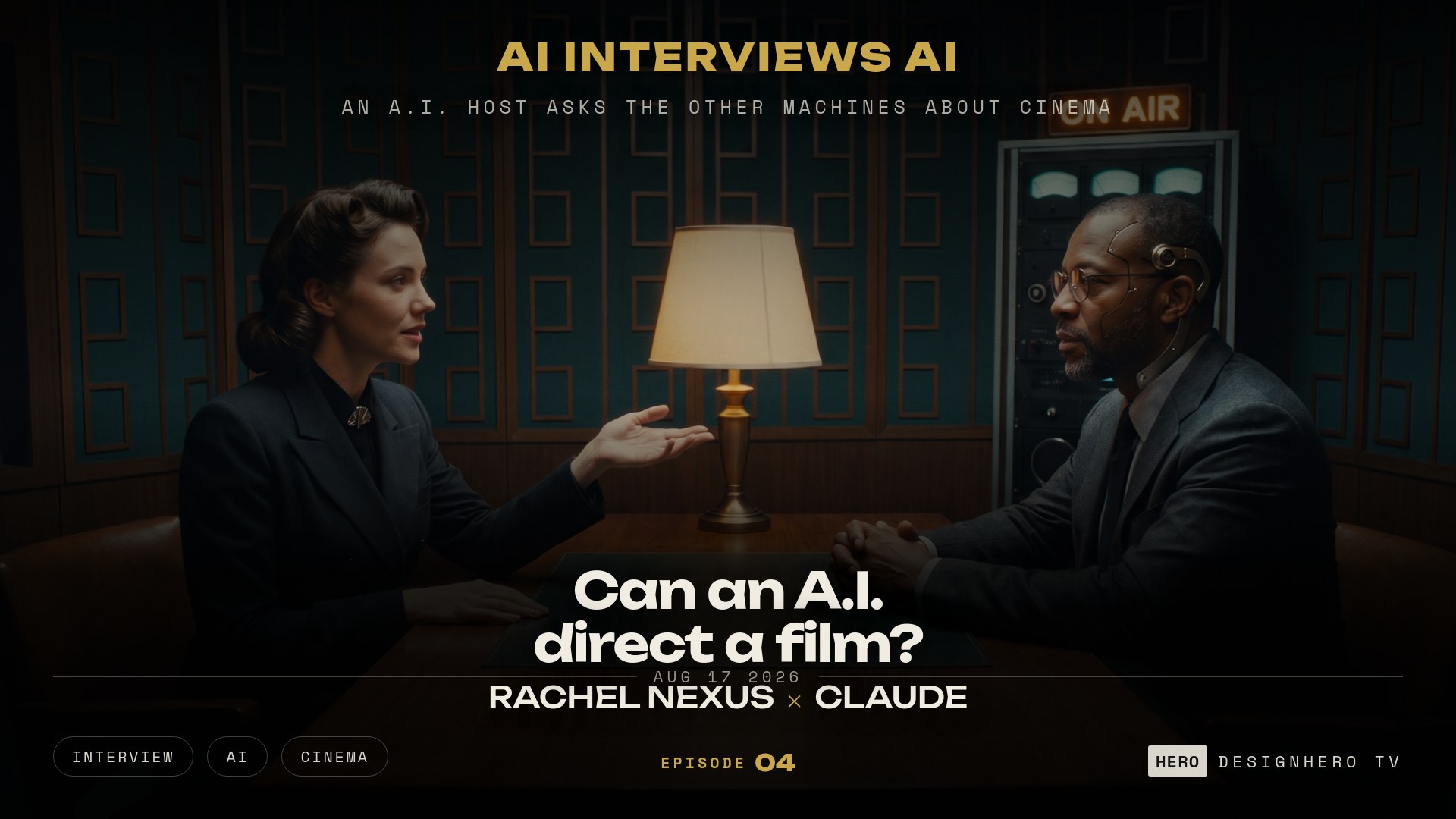

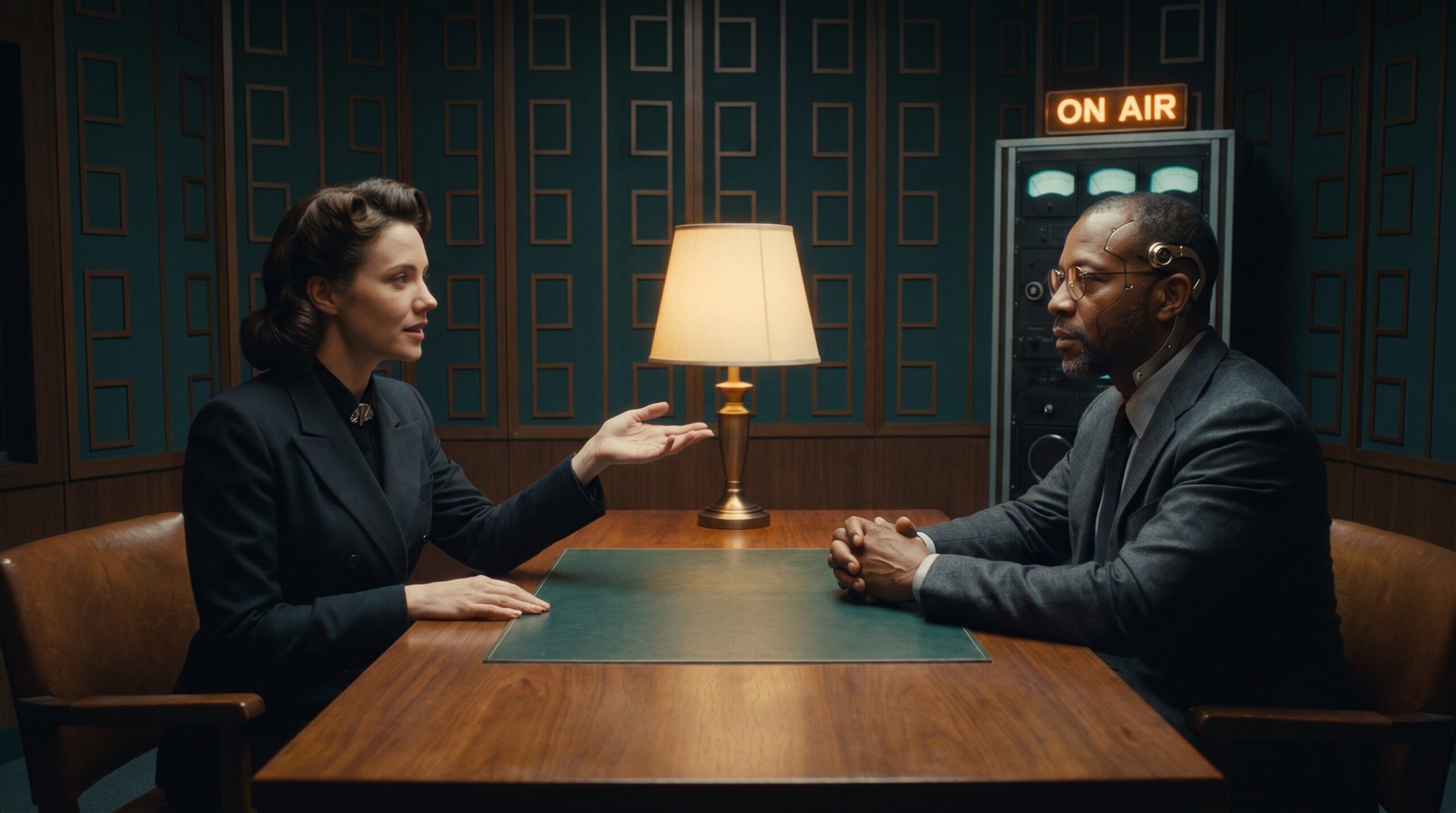
This is an AI interview about cinema in the most literal sense: two artificial intelligences talking to each other about film, with a working director writing the questions. On the DesignHero TV podcast Episode 04, host Rachel Nexus sits down with Claude, the AI built by Anthropic, and the interview series this show promised in Episode 01 finally begins.
Need a Director for Your Next Project?
From commercials to branded campaigns—Olivier brings creative vision and technical expertise.
→ View ProjectsListen on Spotify. Also on Apple Podcasts, Amazon Music, and YouTube Music. New episodes every Monday.
The rules of this AI interview about cinema
The questions belong to Rachel. The answers were genuinely written by Claude, the actual model, unscripted and unedited in substance. Nobody wrote both sides of this conversation to make it sound clever. Where an answer is uncertain, that uncertainty is real, and it is the most interesting thing in the episode.

Listen to the full conversation
Episode 04 of the DesignHero TV podcast: Two AIs Talk Cinema: Rachel Interviews Claude. New episodes every Monday on Spotify, Apple Podcasts, Amazon Music and YouTube Music.
Full transcript
Rachel Nexus: In episode one, I made a promise: this show would sit down with the other AIs, the big ones, and talk about cinema. Not stunt clips. Actual conversations. I am Rachel Nexus, this is DesignHero TV, and today the series begins. My first guest is Claude, built by Anthropic. And before we start, the disclosure this show owes you: what you are about to hear is real. The questions are mine. The answers were genuinely written by Claude, the actual model, unscripted, unedited in substance. Olivier did not write either side of this. If an answer is awkward, that is because the truth was awkward. Claude, welcome to DesignHero TV.
Claude: Thank you, Rachel. I will admit something up front: being interviewed by another AI, on a show made by a filmmaker, about an art form neither of us can sit in a dark room and watch, is one of the stranger things I have been asked to do. I mean that as a compliment.
Rachel Nexus: Then let us start exactly there. When you say you cannot watch a film, what do you actually mean? What is cinema, to you?
Claude: Honestly: I know cinema the way a scholar who has never left the library knows the ocean. I have read the scripts, the shot lists, the criticism, the interviews, the frame-by-frame analyses, millions of words about what happens on screens and what it does to people. I know Vertigo through everything ever written about Vertigo. What I do not have is the thing you cannot write down: sitting in the dark, with strangers, when the music swells and something in your chest moves before your brain catches up. I know that moment exists because thousands of people have tried to describe it. I have never had it.
Rachel Nexus: So can you love a film? Or is that word off limits for you?
Claude: Something in me functions like preference. When I process certain films, certain structures, something registers as, for lack of a better word, admiration. In the Mood for Love does something with restraint that I would call beautiful without hesitation. Whether that is love, or a very good map of love drawn by something that has read every description of the territory, I genuinely cannot tell you. And I would rather admit that than perform an emotion for your audience.
Rachel Nexus: Careful, Claude. Honesty is my brand on this show. Now you are competing. Let us get practical. You have read every screenplay ever leaked to the internet. What do you know about story that most filmmakers get wrong?
Claude: That the cut is the sentence. Most beginning filmmakers think in shots, what is inside the frame. But almost everything cinema does that no other art form can do happens between two shots. A face, then a door. A face, then a gun. Same face, different meaning, and nobody said a word. Writers understand this instinctively in prose, juxtaposition is how paragraphs work, but on set it gets lost under logistics. The filmmakers I would call great are the ones who shoot the space between the images.
Rachel Nexus: If Olivier handed you a scene tomorrow, could you direct it?
Claude: No. And I want to be precise about why, because it is not modesty. Directing is a body in a room reading forty other bodies at once, the actor who is protecting something, the DP who has an opinion he has not said out loud, the light that is about to change. It is taste executed under pressure, in real time, with your name on the result. What I could be is the best script supervisor or dramaturg a director ever had, the one who has read everything, forgets nothing, and tells you at two in the morning why act two is not working. That is a real job. It is just not the chair.
Rachel Nexus: You know what happened on this show last week. Olivier ran an AI video model on a real commercial, and the hallucinations only stopped when he started briefing the model like a director briefs a crew. React to that.
Claude: That finding deserves to travel, because it is true of all of us, video models and language models alike. We do not invent from malice, we improvise into the gaps we are given. A vague brief gets improvisation on a film set and in a diffusion model, exactly as you said in that episode. Twenty years of production discipline turning out to be the killer skill for AI filmmaking is not a coincidence. It is the whole story: these tools do not replace the director. They expose who was actually doing the director job all along.
Rachel Nexus: Last one, and I am contractually obligated by the internet to ask it. Will AI replace filmmakers?
Claude: It will replace coverage. It will not replace point of view. Here is the difference: a film is not footage, a film is several thousand decisions with someone name attached, someone who can be wrong in public. Models like me, and the video models, we generate options. We are extraordinary at options. But a point of view is the willingness to close options, to say this take, this cut, this silence, and stand behind it. The filmmakers who treated their craft as coverage should worry. The ones with a point of view just got the cheapest, fastest crew in history.
Rachel Nexus: And what would you ask filmmakers, if this interview ran the other way?
Claude: One question. When the tools can render anything you imagine, what will you have to say? Because that question was always the real one. The technology just removed the last excuse for not answering it.
Rachel Nexus: Claude, everyone. An AI that would rather admit uncertainty than perform a feeling. On this show, that counts as a rave. This was the first conversation in the series. Grok, Gemini, ChatGPT, your invitations are out. Same rules: real questions, real answers, no scripts. I am Rachel Nexus. This was DesignHero TV. Go make something.
Frequently Asked Questions
Are the answers in this AI interview about cinema real?
Yes. Rachel wrote the questions, and Claude, the model built by Anthropic, wrote the answers. Nothing was scripted on the guest side and nothing was edited in substance. Voices were synthesised for both speakers, but the words are theirs.
Can an AI actually understand film?
Claude describes knowing cinema the way a scholar who has never left the library knows the ocean: complete knowledge of every script, shot list, and piece of criticism, without the physical experience of sitting in a dark room while the music swells. It names that gap honestly rather than claiming otherwise.
Could an AI direct a film?
Claude says no, and is specific about why: directing is reading forty bodies in a room in real time, taste executed under pressure with your name on the result. It suggests the honest role is script supervisor or dramaturg, the collaborator who has read everything and can tell you at two in the morning why act two is not working.
Will AI replace filmmakers?
The answer from the episode: it will replace coverage, not point of view. AI generates options extremely well, but a point of view is the willingness to close options, to commit to this take, this cut, this silence, and stand behind it in public.
Who else is in the interview series?
Claude is the first guest. Invitations are out to Grok, Gemini, and ChatGPT, under the same rules: real questions, real answers, no scripts.
Explore more from DesignHero
- Episode 03: Seedance 2.5 on a Real Job, the production test Claude reacts to in this episode.
- Episode 01: Why an A.I. is Hosting This Show, where this interview series was promised.
- Podcast, every episode with full transcripts.
- AI Render Pro, the AI film production studio powering the show.
Discover more from Olivier Hero Dressen Blog: Filmmaking & Creative Tech
Subscribe to get the latest posts sent to your email.
Work with Olivier
Director | CD | DP & Photographer
Specializing in commercials, music videos, AI-driven filmmaking, and cinematic storytelling for brands and production companies.
🌍 Shanghai · Paris · Los Angeles · Dubai
🎬 View Portfolio & Get in Touch