
Stable Diffusion vs DALL-E commercial rights is a question most studios only ask after the work is already in a client deck. The generation is the easy part. What you are allowed to do with the file, and whether you can stop anyone else using it, is where the money actually sits.
Need a Director for Your Next Project?
From commercials to branded campaigns—Olivier brings creative vision and technical expertise.
→ View ProjectsThis piece is about ownership, licensing and cost rather than image quality. If you want the visual comparison, we ran five identical prompts through both models and published every render in our hands-on GPT Image 2 vs Stable Diffusion 3.5 test.
One caveat before anything else. This is a working summary for creative professionals, not legal advice, and platform terms change without much notice. Verify the licence attached to the specific model version you are using before you sign anything.
Stable Diffusion vs DALL-E commercial rights: two separate questions
Almost every argument about AI image rights goes wrong in the same place. There are two separate questions and they have different answers.
The first is whether you own the image the model produced. The second is whether you are licensed to use the model at all for the purpose you have in mind. A studio can be completely clear on the first and in breach on the second.
Keep them apart and the rest of this becomes straightforward.
What OpenAI actually grants
OpenAI’s Terms of Use are unusually plain. Between you and OpenAI, you retain ownership of your input and you own the output, and OpenAI assigns to you whatever right, title and interest it may have in that output.
On the OpenAI side of Stable Diffusion vs DALL-E commercial rights, that applies whether you are on a free account or an enterprise contract. There is no revenue threshold, no tier gate on commercial use, and no separate licence to buy before a render can go in a campaign.
The limits sit elsewhere. You are responsible for what you feed in, so uploading someone else’s photograph and transforming it does not create permission you did not have. Likeness rules apply to recognisable people. And the usage policies still govern what you can generate at all.
What the Stability Community Licence actually says
This is where the older advice on the internet is now wrong, and where a studio can get caught.
Stable Diffusion 3.5 is released under the Stability AI Community Licence. It preserves free access for people and organisations generating annual revenue below one million US dollars. Above that line, commercial use of the model requires a separate enterprise licence, priced privately.
Two details matter enormously here.
The threshold is organisational revenue, not project revenue or AI revenue. A production company turning over more than a million dollars crosses it even if the AI work is a rounding error on one job.
And it attaches to the model version. The older releases, Stable Diffusion 1.5 and SDXL, sit under CreativeML Open RAIL-M, which carries no revenue limit at all. Plenty of studios are running those quite legitimately while assuming the newer licence applies to them, or the reverse.
Crucially, the Community Licence still affirms that you own the media you generate and may distribute and commercialise it independently of the restrictions on the model weights. So the revenue trigger governs your right to run the model, not your right to the pictures it made.
Stable Diffusion vs DALL-E commercial rights at a glance
Reduced to the only three things that actually change a decision:
Output ownership. Both assign it to you. This is not a differentiator, whatever the comparison posts say.
Model licence. OpenAI has no revenue gate. Stability’s current models have one at a million dollars. Older Stability models have none.
Where the cost lands. OpenAI charges per generation, forever. Stability can cost nothing per image once you own the hardware, provided you stay under the threshold or buy the enterprise licence.
How the other two compare
Two tools come up immediately whenever this is discussed, and both change the picture.
Midjourney splits commercial rights by subscription tier. Free and entry plans permit personal use only. Paid plans from the Standard tier upward carry a commercial licence. There is also a carve-out worth knowing: companies above one million dollars in annual revenue are required to be on the higher tiers to use output commercially, regardless of which plan they happen to be on.
Midjourney also retains the right to use your prompts and images to improve its models, and the stealth option on higher plans keeps work out of the public gallery without changing that.
Adobe Firefly takes the opposite approach and sells indemnity as the product. It was trained on licensed Adobe Stock and public domain material specifically to sidestep the training-data disputes hanging over the others, and paid plans carry full commercial rights. For an agency whose client contracts contain IP warranties, that provenance argument frequently outweighs any comparison of output quality.
The pattern across all four is worth noting. Three of them now put a line at one million dollars in revenue. If your company is near that number, the licensing question stops being academic across your whole toolset at once.
The part nobody puts in the comparison table
Every discussion of Stable Diffusion vs DALL-E commercial rights stops here, and it should not. Owning an image and being able to defend it are different things, and this catches people out badly.
Under current US law, purely AI-generated images are not copyrightable, because copyright requires human authorship. The platform can assign you its rights, and that assignment binds the platform. It does not bind anyone else, because there was no copyright there to transfer.
OpenAI says as much in its own terms: output may not be unique, other users may receive similar output, and the assignment does not extend to other users’ output.
So a client can put your AI render on a billboard, and a competitor can run something near-identical the following week, and you have no infringement claim to bring. For a brand paying for distinctiveness, that is a real exposure and it applies equally to both models.
The practical mitigation is the thing you were probably doing anyway. Substantial human work on top of the generation, compositing, retouching, art direction inside a larger piece, strengthens a copyright claim in the human contribution. A raw render straight out of the box is the weakest position available.
Self-hosted or API: same rights, different exposure
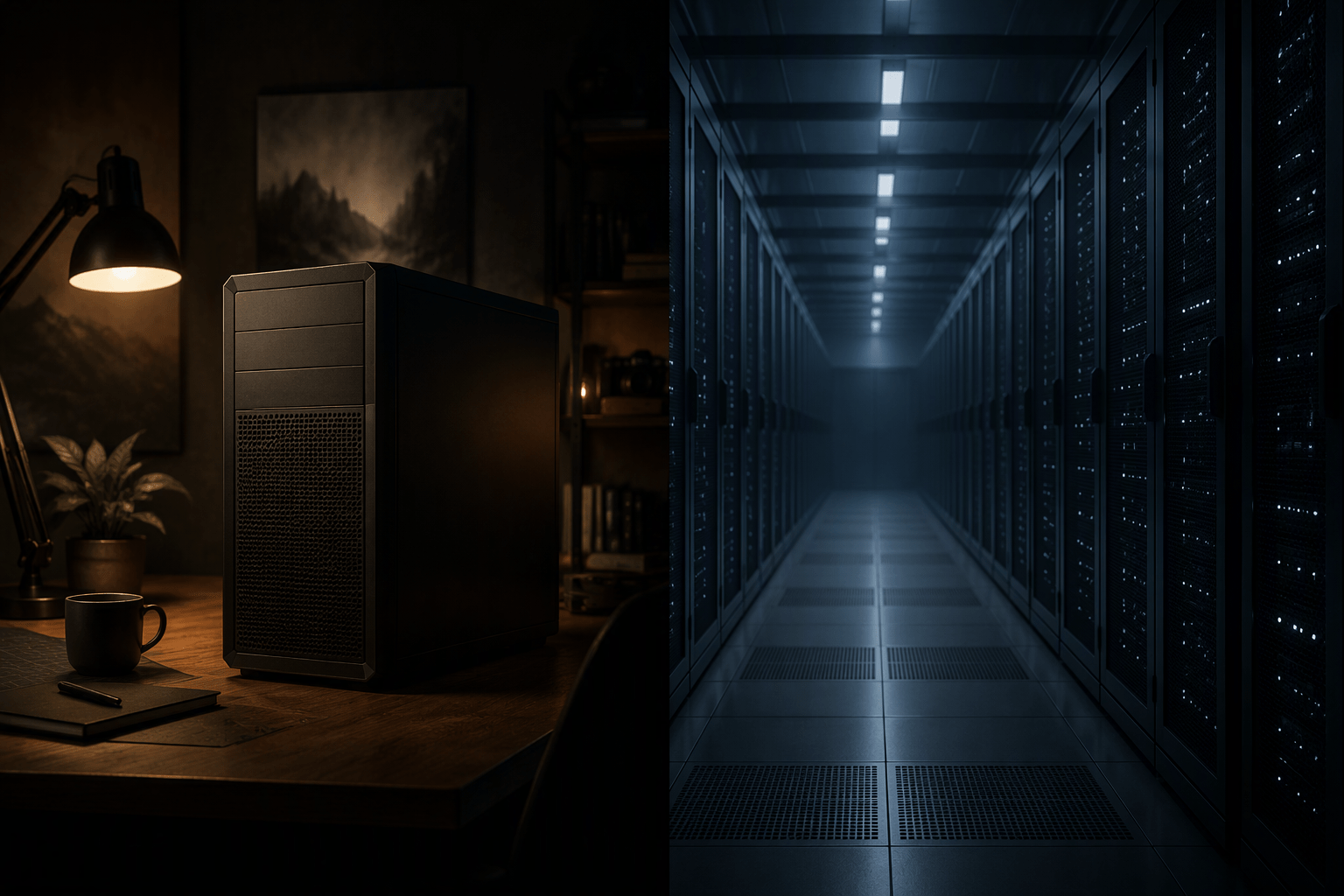
Running Stable Diffusion on your own machine versus calling it through an API does not change your ownership of the outputs. It changes what the vendor sees.
Self-hosted, nothing leaves your building. For a studio under NDA on an unannounced campaign, that is often the entire argument, ahead of any question of cost or quality.
Through a hosted API, inputs and outputs may be retained and used to improve models unless you exercise the available opt-out. If you are pushing client concepts through a hosted endpoint without checking that setting, check it today.
Cost models for a working studio
The economics diverge sharply depending on volume.
OpenAI is priced per image. It is close to free for a director generating a handful of boards a week, and it stays proportional to use, which finance departments like. There is no capital outlay and no maintenance.
Self-hosted Stable Diffusion inverts that. You buy a GPU once, then the marginal cost of a render is electricity. If you are producing hundreds of variants exploring a look, that difference stops being theoretical quickly. Most post houses already own hardware that will run it.
The honest break-even sits at volume plus privacy. Low volume, no NDA pressure, use the API and stop thinking about it. High volume or confidential work, self-hosting pays for itself and keeps the material in-house. Just check which side of the revenue line your company sits on first.
Fine-tuning and the case for open weights
The strongest argument for Stable Diffusion is not price and not quality. It is that you can train it on your own material.
Custom checkpoints and LoRA adapters let a studio teach a model a specific character design, a house grade, a recurring set, a visual language built over years. That capability does not exist in a closed model, at any price.
For anyone building a proprietary look rather than borrowing a generic one, that is decisive, and it is worth more than winning any single render comparison.
A Stable Diffusion vs DALL-E commercial rights checklist
Confirm which model version you are actually running, because the licence follows the version.
Check your organisation’s annual revenue against the one million dollar line if you are on current Stability models.
Assume raw AI output is not protectable and build human work on top of it where distinctiveness matters.
Check the training opt-out on any hosted endpoint carrying confidential material.
Keep your prompts, versions and edit history. If a copyright question ever arises, evidence of human creative direction is the thing that helps you.
Stable Diffusion vs DALL-E commercial rights comes down to those five checks rather than to which model draws better. For more on how these tools fit a production pipeline, see our AI prompting and image generation hub.
Discover more from Olivier Hero Dressen Blog: Filmmaking & Creative Tech
Subscribe to get the latest posts sent to your email.
Work with Olivier
Director | CD | DP & Photographer
Specializing in commercials, music videos, AI-driven filmmaking, and cinematic storytelling for brands and production companies.
🌍 Shanghai · Paris · Los Angeles · Dubai
🎬 View Portfolio & Get in Touch