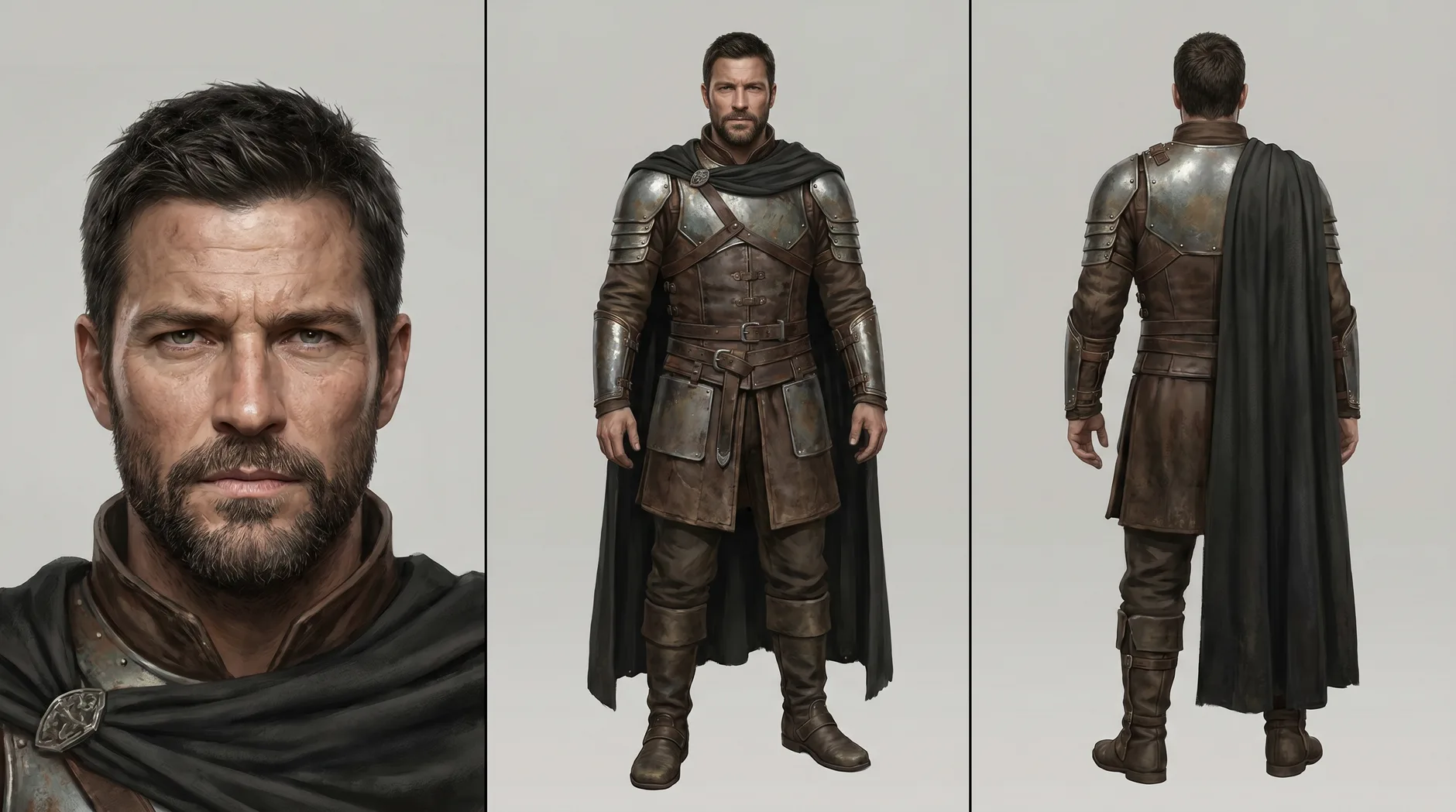
First insight — Precise character design prompts are indispensable for generating focused, usable AI visual assets, enabling artists to define every nuance of their creations from concept to turnaround.
Craft highlight — Utilizing AI for character design streamlines the pre-production pipeline, offering rapid iteration and consistent visual development for diverse archetypes, from heroes to creatures.
Industry context — AI tools like AI Render Pro are transforming how filmmakers and creatives approach visual development, making professional-grade character sheets accessible and efficient.
Bottom line — Mastering the art of detailed AI prompting for character design turnaround sheets is a critical skill for modern visual storytelling, ensuring clarity and artistic integrity in your projects.
The core of compelling visual storytelling begins with robust character design, and in the age of generative AI, precise prompts are your most potent tool. These detailed directives allow you to articulate your vision with clarity, guiding AI to produce accurate, consistent, and production-ready character reference sheets, complete with essential turnaround views and specific stylistic details. This article provides 15 essential character design prompts, offering a framework for artists to harness AI for their creative pipeline.
Need a Director for Your Next Project?
From commercials to branded campaigns—Olivier brings creative vision and technical expertise.
The Imperative of Precise Character Design Prompts
In the demanding landscape of film, animation, and game development, the initial phase of visual development is paramount. Character design forms the very backbone of a narrative, providing visual anchors for audience engagement and emotional resonance. Historically, this process involved extensive sketching, concept art, and detailed discussions with teams of artists. Today, AI-driven tools are revolutionizing this workflow, offering unprecedented speed and iterative capability. However, this power is only as effective as the prompts you provide. Generic prompts yield generic results; specific, well-structured prompts unlock the AI’s full potential, transforming vague ideas into concrete, actionable visual assets.
For any creative director or filmmaker, time is a non-renewable resource. The ability to rapidly generate multiple character design iterations, complete with essential turnaround views, means more time spent on refinement and less on initial concept generation. This isn’t about replacing human creativity but augmenting it, allowing artists to explore a wider range of possibilities in a fraction of the time. The precision in your character design prompts directly translates to the quality and usability of the output, ensuring that the AI understands not just what you want, but how it should look, feel, and function within your story’s universe. This strategic approach to prompting is what separates amateur attempts from professional-grade asset creation. It’s about leveraging technology to push creative boundaries, not just to automate tasks. The core of this efficiency lies in understanding how to communicate your artistic intent to a machine, a skill that is rapidly becoming as crucial as traditional drawing or sculpting. For those looking to streamline their creative process, understanding essential tools and gear for modern production is key.
The precision required in these prompts mirrors the meticulous detail needed in any aspect of film production, from blocking a scene to selecting the right lens. Just as a director provides clear instructions to their crew, a prompt engineer must provide unambiguous directives to the AI. This clarity ensures that the generated character design aligns perfectly with the project’s aesthetic and narrative requirements. Without it, you risk wasting valuable time and resources on outputs that miss the mark. This focused approach is particularly vital when developing complex universes, where consistency across numerous characters is non-negotiable. Embracing this level of detail in your prompts means embracing a more efficient, controlled, and ultimately more creative workflow.
Beyond Concept Art: The Power of AI Turnaround Sheets
Concept art serves as the initial spark, a visual exploration of ideas. However, for actual production—be it 3D modeling, animation, or costume design—a simple front-facing illustration is rarely sufficient. This is where character turnaround sheets become indispensable. A turnaround sheet provides multiple views of a character (front, back, often sides and three-quarters), detailing their proportions, costume elements, and intricate features from all angles. This comprehensive visual guide ensures consistency across all departments, preventing costly errors and maintaining the artistic integrity of the character.
Traditionally, creating these detailed turnaround sheets was a labor-intensive process, demanding significant artistic skill and time. With AI, specifically tools like AI Render Pro — the prompting tool for filmmakers and creatives, this process is dramatically accelerated. By crafting specific prompts that request a “character turnaround sheet” with defined views, artists can generate production-ready references in minutes. This capability is a game-changer for independent filmmakers and large studios alike, democratizing access to high-quality visual development assets. Imagine the impact on a project’s timeline when detailed character references can be generated and iterated upon almost instantly, freeing up human artists to focus on the more nuanced, expressive aspects of their craft.
The value of these AI-generated turnaround sheets extends beyond mere speed. They enforce a level of consistency that can be challenging to maintain across a large team of human artists. Every line, every texture, every detail is generated based on the initial prompt, ensuring a unified vision. This consistency is crucial for projects with extensive character rosters or those requiring meticulous adherence to a specific art style. For those working on projects with tight deadlines, this efficiency is not just a luxury; it’s a necessity. It allows for a more agile development pipeline, where feedback can be incorporated and new iterations produced with unparalleled speed. The implications for industries relying on visual assets, from video games to animated features, are profound. The ability to quickly visualize and refine a character’s full physical presence from all angles is a cornerstone of effective character development. Discover more about the impact of AI on creative workflows in our article on AI education for filmmakers.
This One Prompt Fixes AI Character Consistency (Use This)
Crafting Your Vision: Deconstructing the Effective Character Design Prompt
An effective character design prompt is a blueprint, a detailed instruction set that leaves minimal room for ambiguity. It moves beyond simple descriptions, delving into the specifics of visual style, mood, context, and technical requirements. For AI-generated character reference sheets, this means including explicit directives for composition, lighting, background, and output format. Think of it as writing a script for a visual artist, where every detail matters.
The anatomy of a robust character design prompt often includes several key components:
Subject Description: Who is the character? What are their core traits, age, gender, race, build?
Attire and Accessories: What are they wearing? Describe specific garments, armor, jewelry, weapons, or tools. Detail materials, textures, and colors.
Art Style and Aesthetic: Is it realistic, stylized, anime, cyberpunk, fantasy? Specify influences or artistic movements. This is critical for the AI to understand the desired visual language.
Mood and Personality: Does the character exude confidence, menace, wisdom, innocence? This can be conveyed through subtle details in their posture, expression, or design elements.
Technical Specifications: This is where the prompt becomes a powerful tool for production. For turnaround sheets, this includes:
Composition: Explicitly state “front-facing face close-up, full front body view, and a full back body view together as one character turnaround sheet.”
Background: “plain neutral light grey seamless studio background” ensures focus on the character.
Lighting: “flat even studio lighting” is crucial for clear reference.
Aspect Ratio: “16:9” for consistent output.
Exclusions: “absolutely no text, logos or watermarks” to keep the sheet clean and professional.
By meticulously detailing each of these elements, you provide the AI with a comprehensive brief, minimizing creative guesswork and maximizing the likelihood of a successful output. This methodical approach is particularly important when working with tools like AI Render Pro, which thrives on structured input. The more precise your prompt, the less time you will spend on iterative adjustments, leading to a significantly more efficient workflow. This level of detail in prompting is not just about getting a good image, but about getting the right image for your specific production needs. For more on advanced AI techniques, explore AI prompts for editorial fashion, which shares principles applicable to character design.
Archetypes Unveiled: Prompting for Diverse Character Design
🎬 AI Render Pro — The prompting system I built for filmmakers and creatives. 6 video engines, 6 image engines, cinema-grade prompt engineering built in. Every AI image on this blog was made with it. Try it for $9/month →
The world of storytelling thrives on diverse characters, each fitting into established archetypes while possessing unique characteristics. From the valiant hero to the cunning villain, the ancient creature to the futuristic soldier, and the mystical mage, each archetype demands specific visual cues that communicate their role and nature instantly. When crafting character design prompts for AI, understanding these archetypes allows for more targeted and effective generation. It’s about leveraging collective understanding of visual language to inform your AI.
For a hero, you might emphasize strength, nobility, and perhaps a touch of weariness from past battles. A villain, conversely, requires elements that convey menace, deceit, or raw power. For a creature, the focus shifts to anatomy, texture, and how its form communicates its origin or abilities. A sci-fi soldier needs practical, functional armor and gear, reflecting advanced technology and combat readiness. A fantasy mage will be defined by their attire, magical implements, and an aura of arcane knowledge.
The beauty of AI in this context is its ability to synthesize vast amounts of visual data associated with these archetypes. Your prompt acts as a filter, guiding the AI to pull relevant design elements and combine them into a coherent, unique character. This is where the power of specific keywords and descriptive language truly shines. Instead of simply saying “hero,” you specify “muscular medieval knight, ornate plate armor, battle-scarred.” For a “creature,” you might write “gargantuan forest guardian, bark-like skin, glowing bioluminescent moss, ancient roots.” These details, combined with the consistent technical specifications for turnaround sheets, ensure that the AI delivers not just a character, but your character, ready for integration into your project. This systematic approach to character design ensures that every character, no matter their archetype, contributes meaningfully to the visual narrative. For inspiration on creating distinct worlds, consider exploring ultimate cyberpunk prompts or stunning retro prompts for AI art.
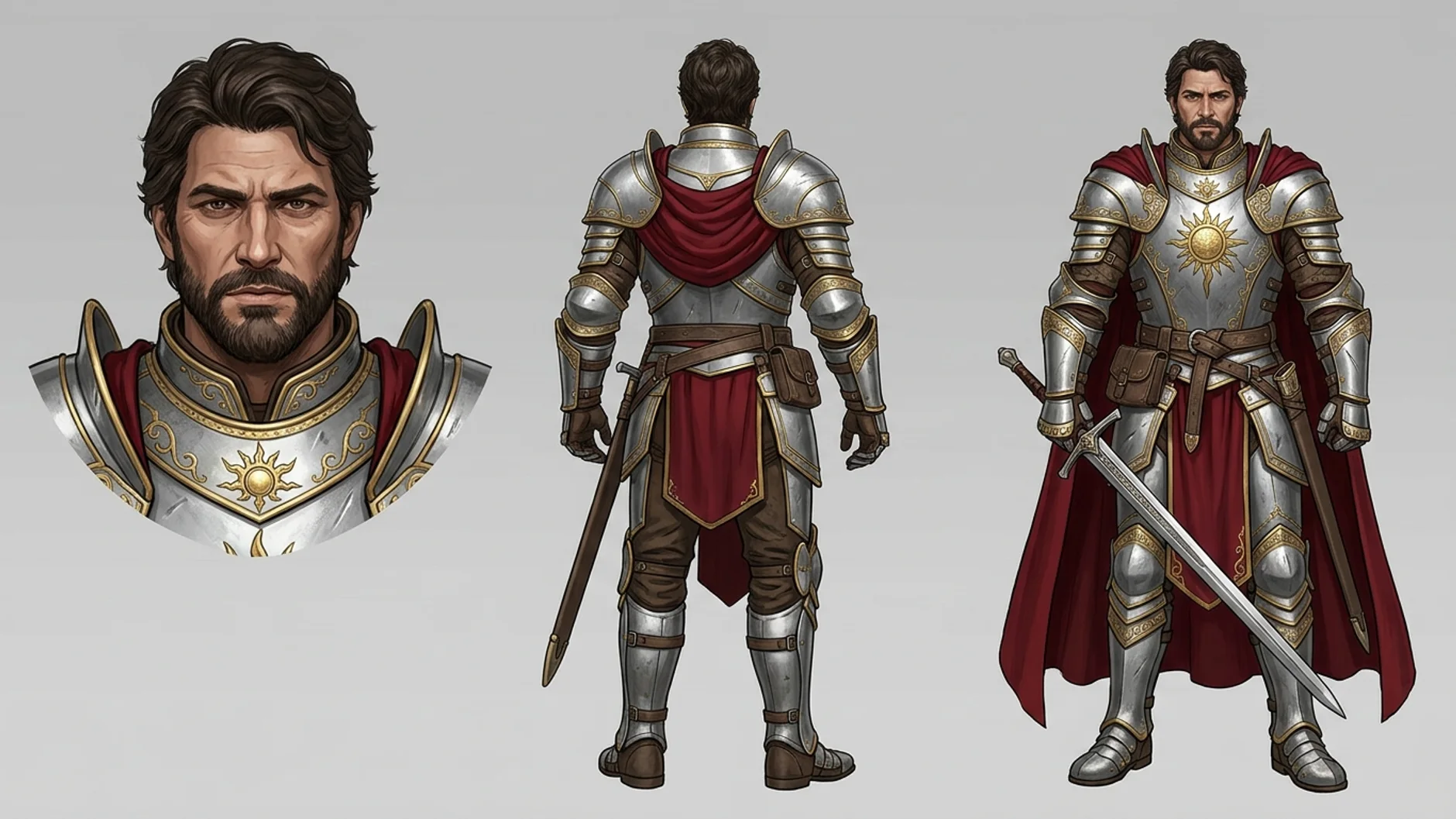
Prompt 1: The Valiant Hero
Creating a hero requires balancing strength, approachability, and a hint of their journey. This prompt focuses on a classic, almost archetypal heroic figure, emphasizing a blend of fantasy and practical design, suitable for a wide range of adventurous narratives. The goal is a character that feels both powerful and relatable, with clear visual cues for their role.
Prompt:AI-generated illustration | AI Render Pro
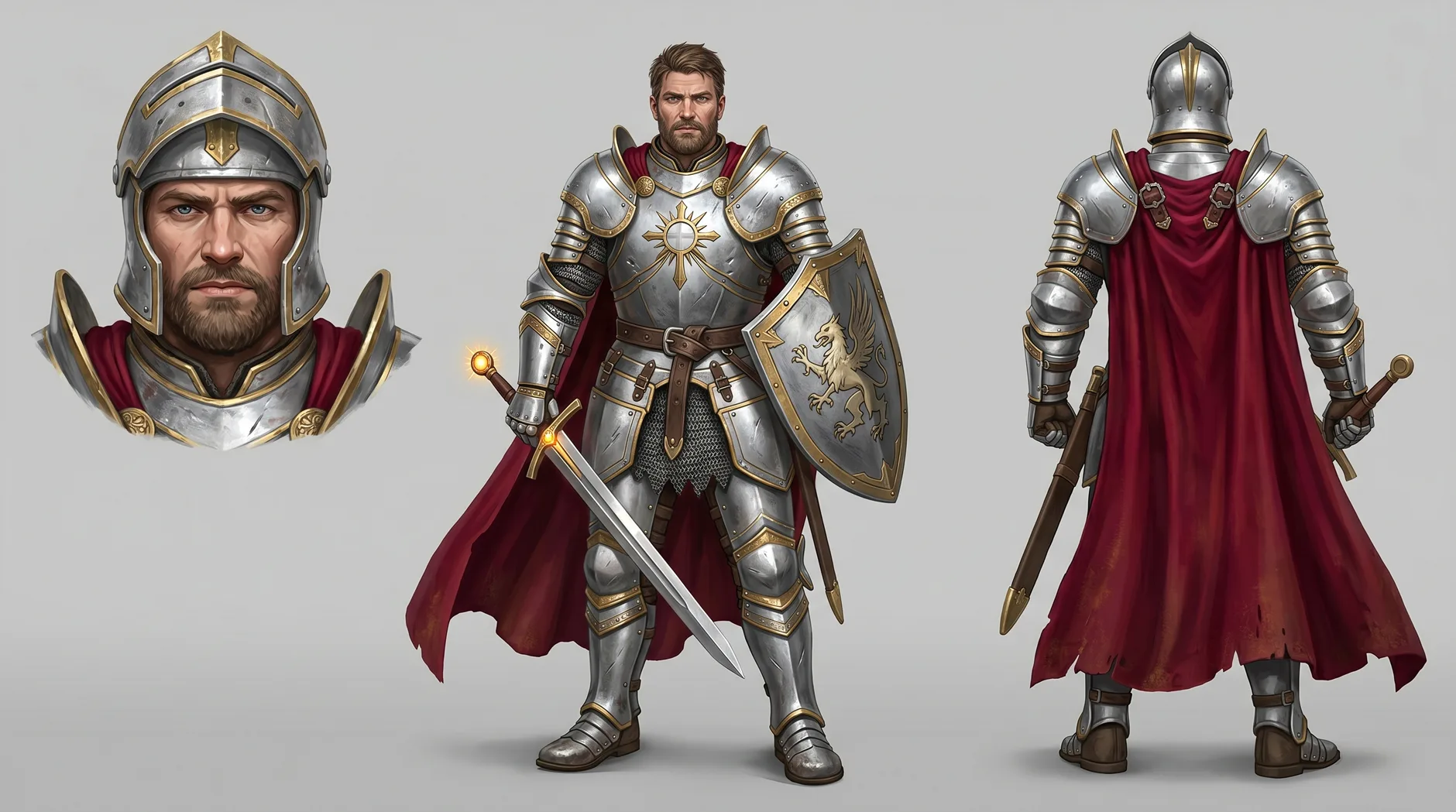
AI Render Pro character reference sheet, full body character turnaround, includes front-facing face close-up, full front body view, and full back body view. A valiant male paladin hero, mid-30s, strong build, wearing intricately designed shining silver full plate armor with gold trim, a flowing crimson cape, and a holy symbol emblazoned on his chest. His armor shows subtle signs of battle wear, adding realism. Dynamic, determined expression. Plain neutral light grey seamless studio background, flat even studio lighting, 16:9 aspect ratio, absolutely no text, logos or watermarks.
This prompt effectively generates a detailed visual reference for a classic heroic figure. The combination of “paladin hero” with specific armor details and a “determined expression” guides the AI toward the desired archetype, while the battle wear adds depth. Ensure you run multiple variations to capture subtle facial nuances.
Prompt 2: The Enigmatic Villain
A truly compelling villain is often defined by their mystery and a sense of underlying power. This prompt aims for an enigmatic sorceress, whose design hints at ancient knowledge and sinister intent without being overtly monstrous. The elegance of her design should contrast with her malevolent nature, making her visually striking.
AI-generated illustration | AI Render Pro
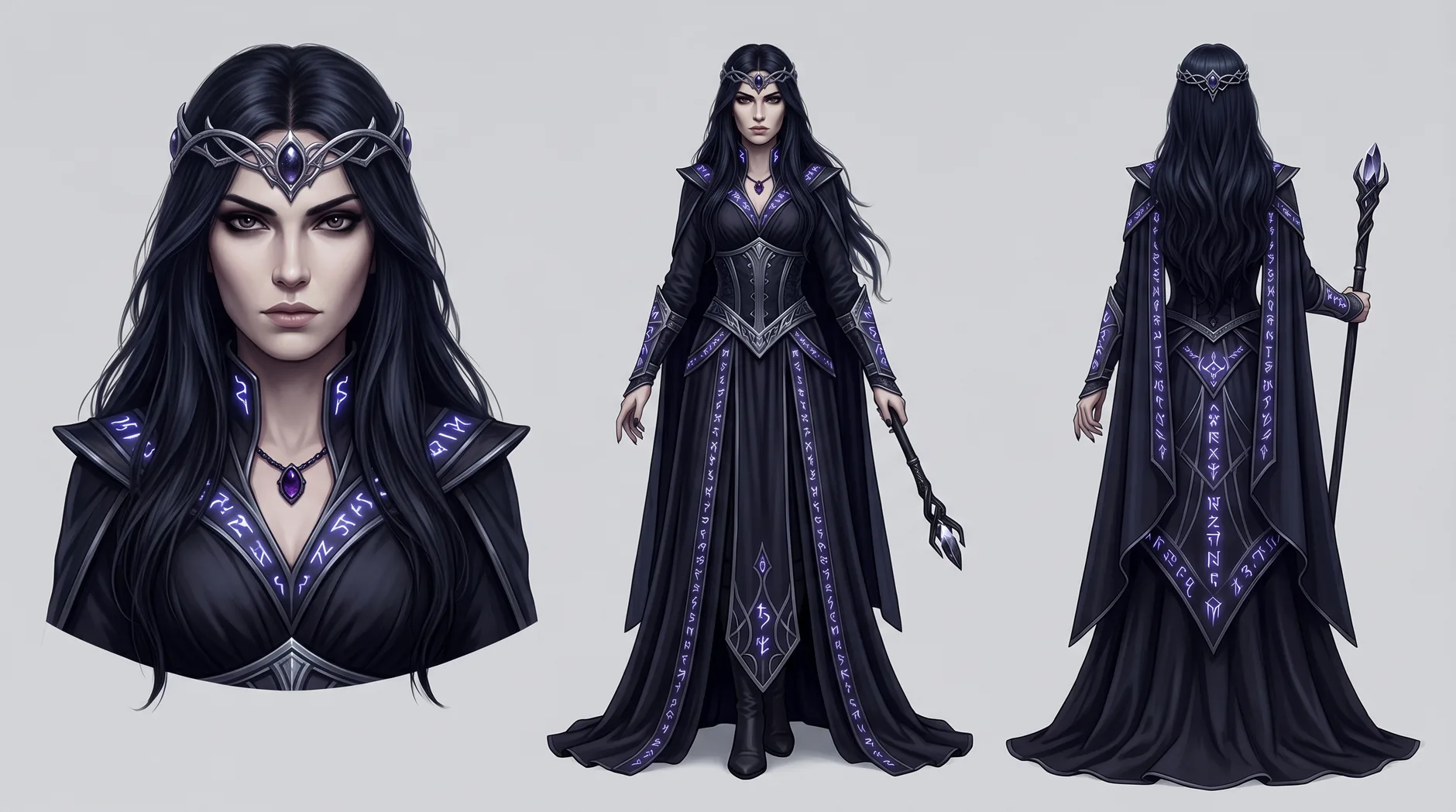
AI Render Pro character reference sheet, full body character turnaround, includes front-facing face close-up, full front body view, and full back body view. An enigmatic female shadow sorceress, slender yet imposing figure, cloaked in flowing dark obsidian robes with subtle glowing arcane runes, intricate silver circlet adorned with a dark gem, long raven hair cascading down her back. Her eyes possess a piercing, calculating gaze. Plain neutral light grey seamless studio background, flat even studio lighting, 16:9 aspect ratio, absolutely no text, logos or watermarks.
This prompt focuses on creating a villain with an aura of dark power and sophistication. The “obsidian robes” and “glowing arcane runes” establish her magical alignment, while the “calculating gaze” defines her personality. Pay attention to how the AI renders the subtle glow and material textures for optimal results.
Prompt 3: The Ancient Creature
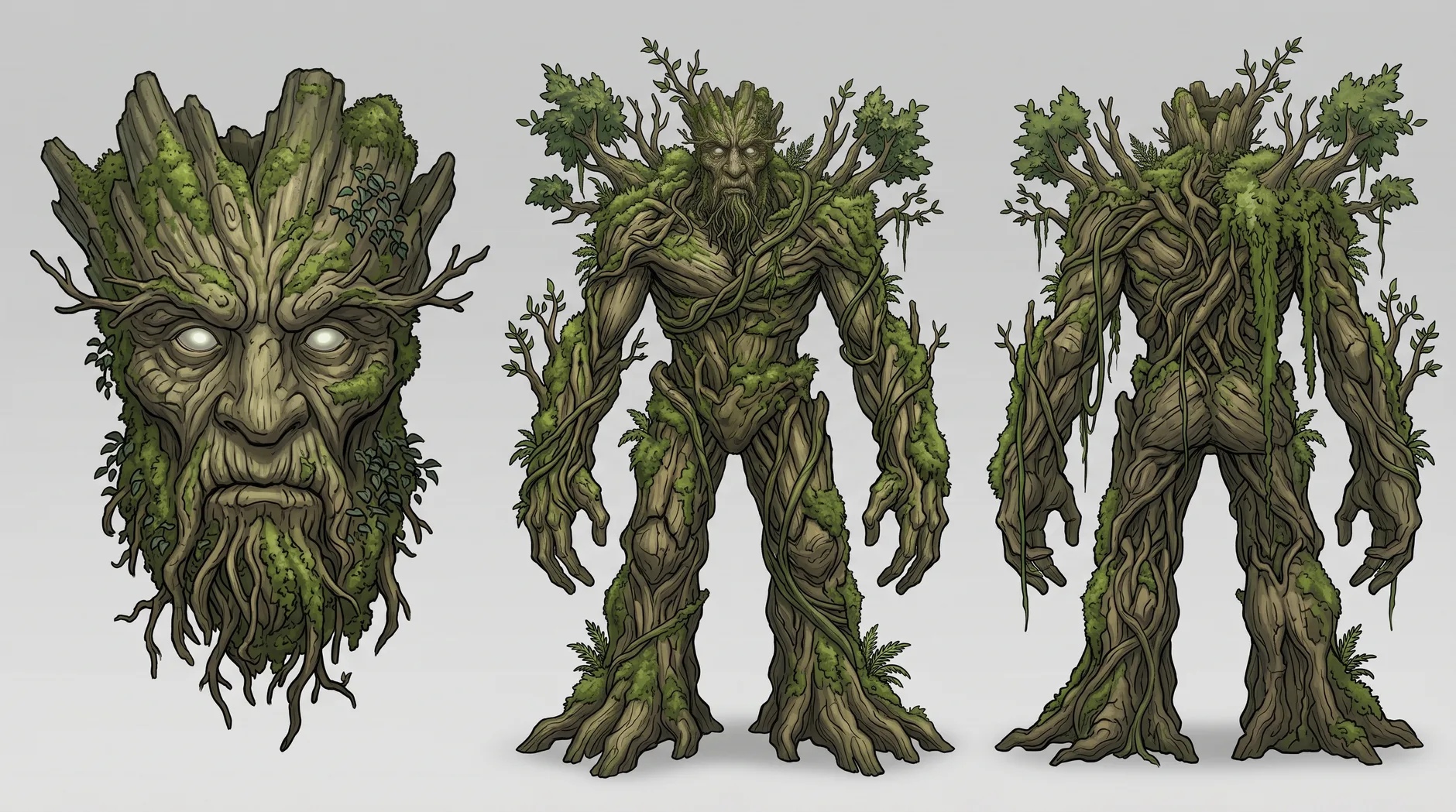
Designing a creature presents a unique set of challenges, requiring attention to anatomy, texture, and how its form conveys its nature. This prompt targets an ancient, mystical forest guardian, blending organic elements with a sense of immense age and power, distinct from humanoids.
AI-generated illustration | AI Render Pro
AI Render Pro character reference sheet, full body character turnaround, includes front-facing face close-up, full front body view, and full back body view. A colossal ancient forest guardian creature, resembling an anthropomorphic tree golem, covered in gnarled bark, vibrant green moss, and intertwining vines. Its eyes glow with a soft, ethereal light. Deep roots form its powerful legs, branches for arms. Its surface is textured with aged wood and living flora. Plain neutral light grey seamless studio background, flat even studio lighting, 16:9 aspect ratio, absolutely no text, logos or watermarks.
This prompt generates a complex non-humanoid creature, emphasizing natural textures and magical elements. The description of “bark-like skin,” “moss,” and “glowing ethereal light” helps the AI create a cohesive and detailed design. Focus on the integration of organic elements and the sense of scale in the generated images.
Prompt 4: The Cybernetic Soldier
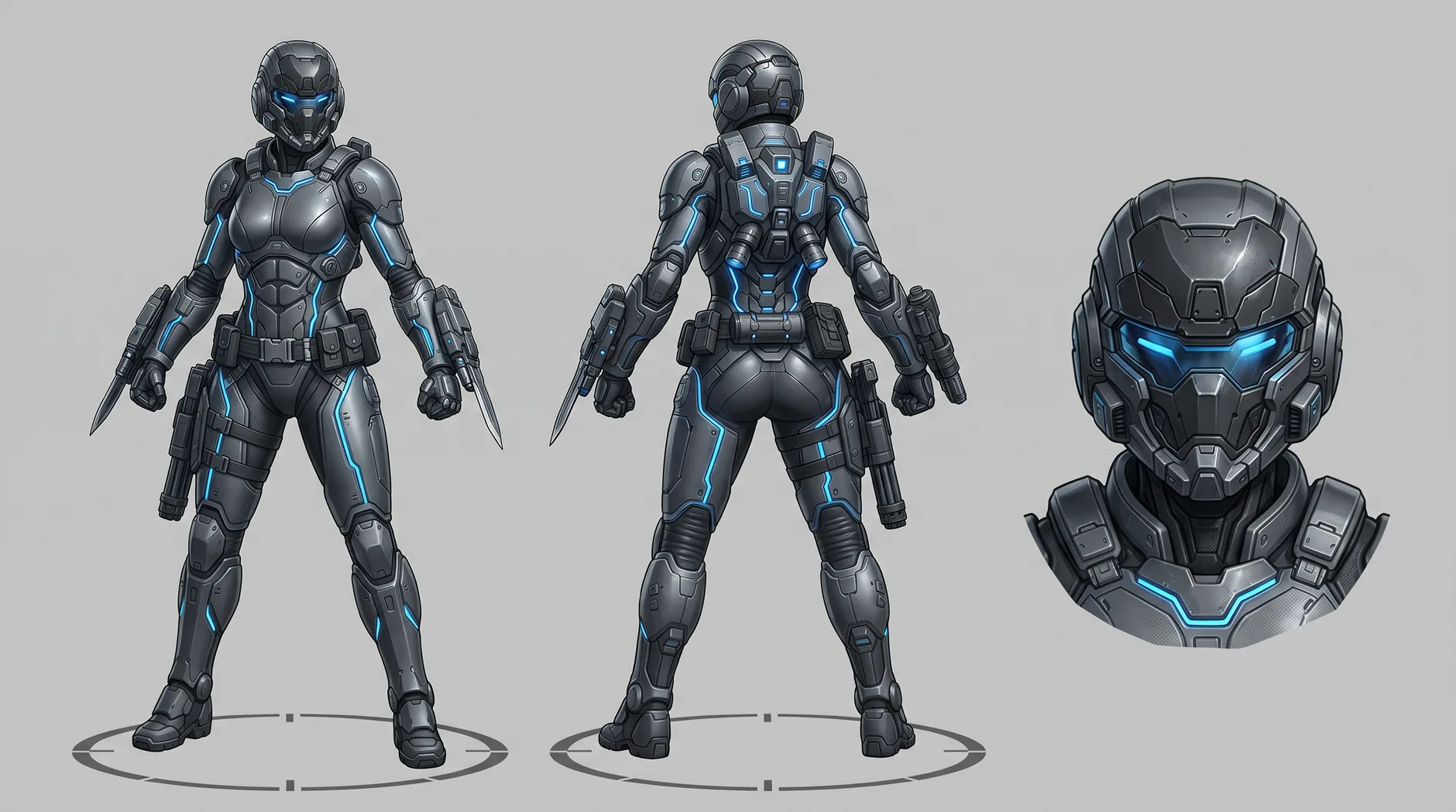
The sci-fi soldier archetype demands a blend of advanced technology, combat readiness, and often, a sense of utilitarianism. This prompt focuses on a highly armored, practical cybernetic soldier, emphasizing functionality and a futuristic aesthetic, crucial for world-building in science fiction.
AI-generated illustration | AI Render Pro
AI Render Pro character reference sheet, full body character turnaround, includes front-facing face close-up, full front body view, and full back body view. An elite female cybernetic soldier, wearing sleek, dark grey armored plating with glowing blue energy conduits, a combat helmet obscuring her face, and integrated weapon systems on her forearms. Her stance is ready for combat, powerful and agile. The armor features subtle futuristic texturing and hard-surface detailing. Plain neutral light grey seamless studio background, flat even studio lighting, 16:9 aspect ratio, absolutely no text, logos or watermarks.
This prompt is designed to produce a highly detailed sci-fi military character. The emphasis on “sleek dark grey armored plating,” “glowing blue energy conduits,” and “integrated weapon systems” ensures a functional and futuristic look. Pay close attention to the hard-surface rendering and the overall silhouette for maximum impact.
Prompt 5: The Arcane Mage
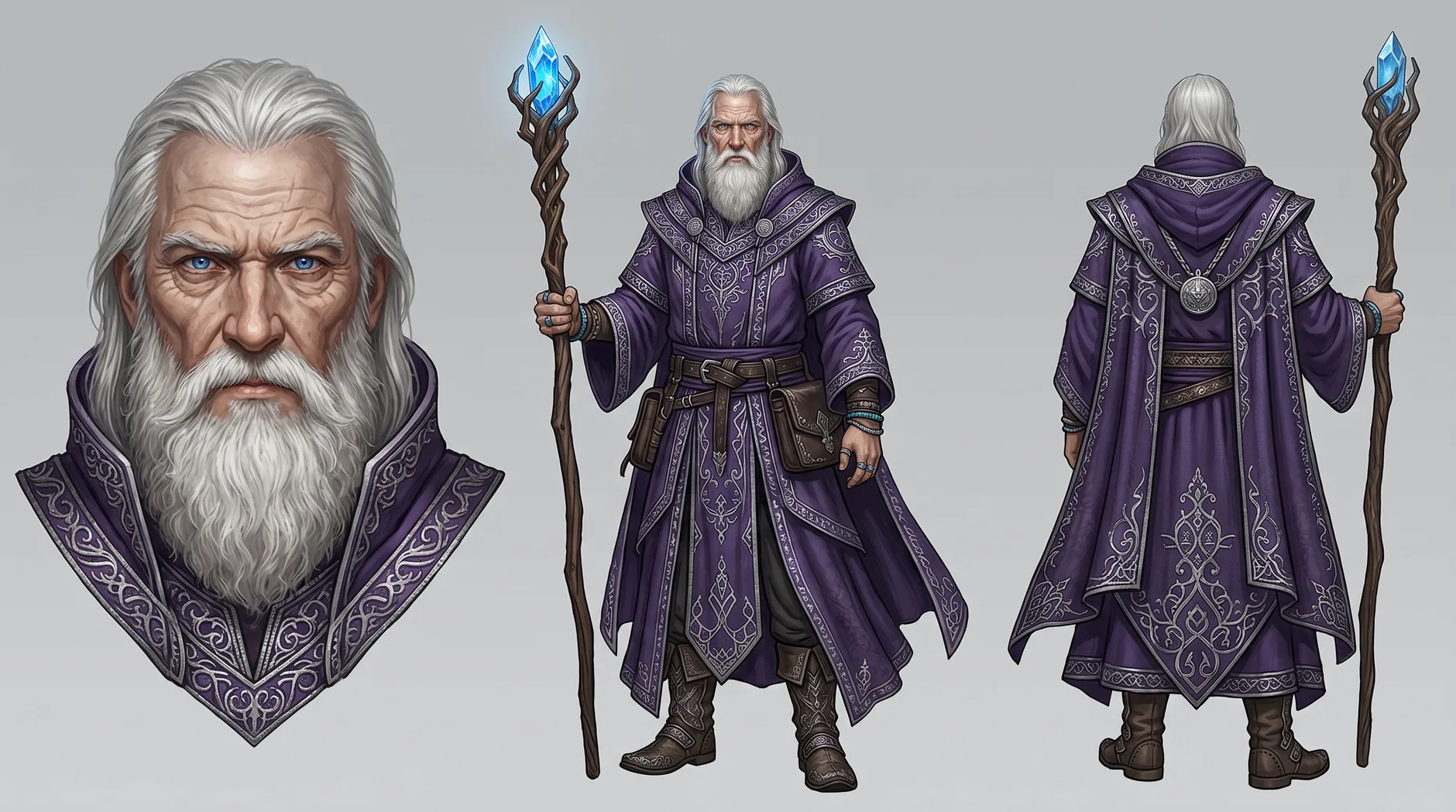
A fantasy mage embodies knowledge, power, and often a touch of the eccentric. This prompt aims for a wise, powerful arcane mage, whose attire and accessories speak to their mastery of magic and long years of study. The design should convey both scholarly wisdom and formidable magical capability.
Prompt:AI-generated illustration | AI Render Pro
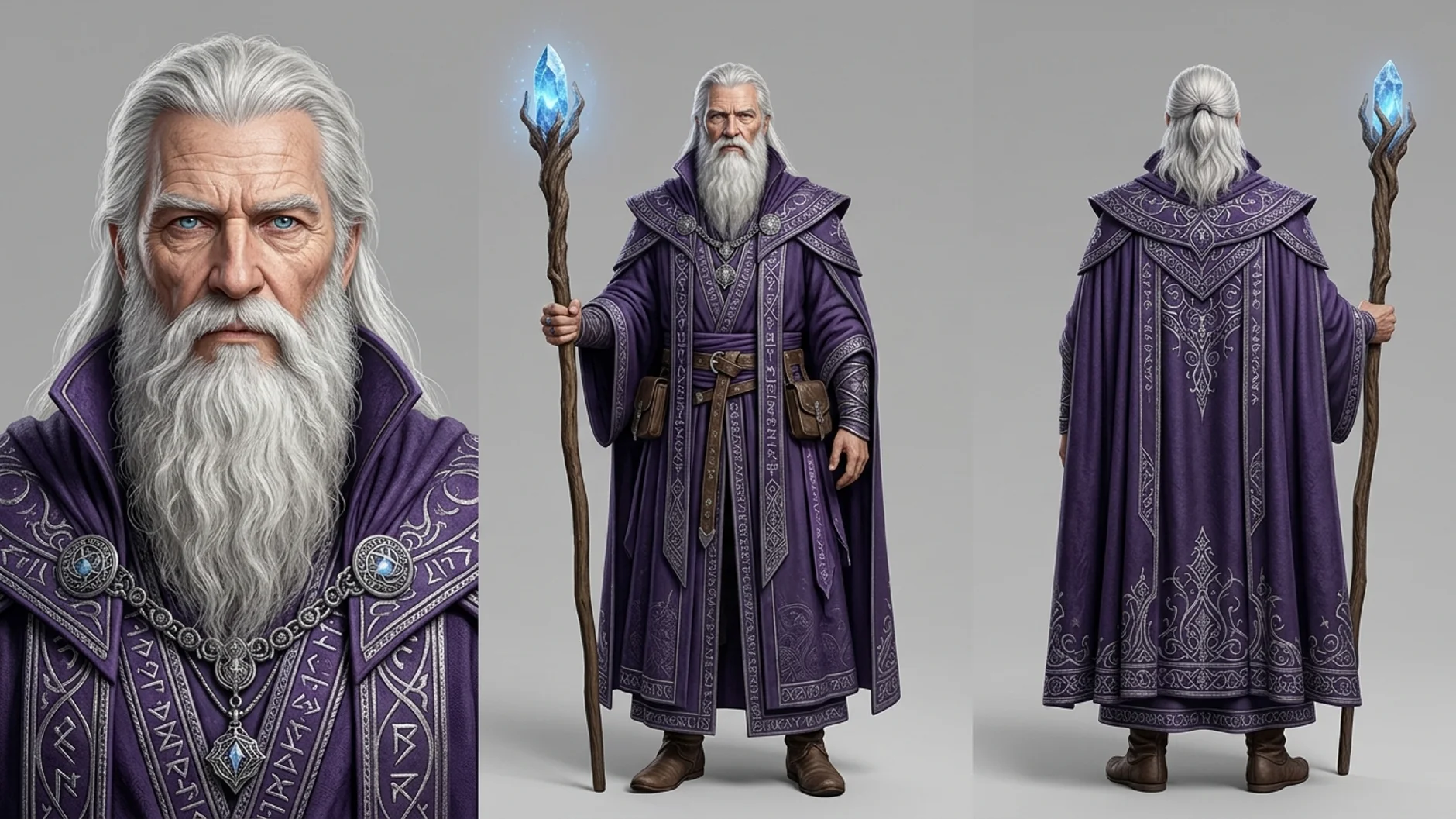
AI Render Pro character reference sheet, full body character turnaround, includes front-facing face close-up, full front body view, and full back body view. A wise male grand arcane master mage, aged but vital, with a long white beard and piercing blue eyes. He wears layered, intricate deep purple robes adorned with silver embroidery, holding a gnarled wooden staff topped with a glowing crystal. His attire suggests ancient knowledge and immense magical power. Plain neutral light grey seamless studio background, flat even studio lighting, 16:9 aspect ratio, absolutely no text, logos or watermarks.
This prompt creates a classic fantasy mage, highlighting wisdom and magical prowess. The “layered, intricate deep purple robes” and “gnarled wooden staff with a glowing crystal” are key visual identifiers. Experiment with different crystal colors and robe patterns to refine the character’s specific magical affinity.
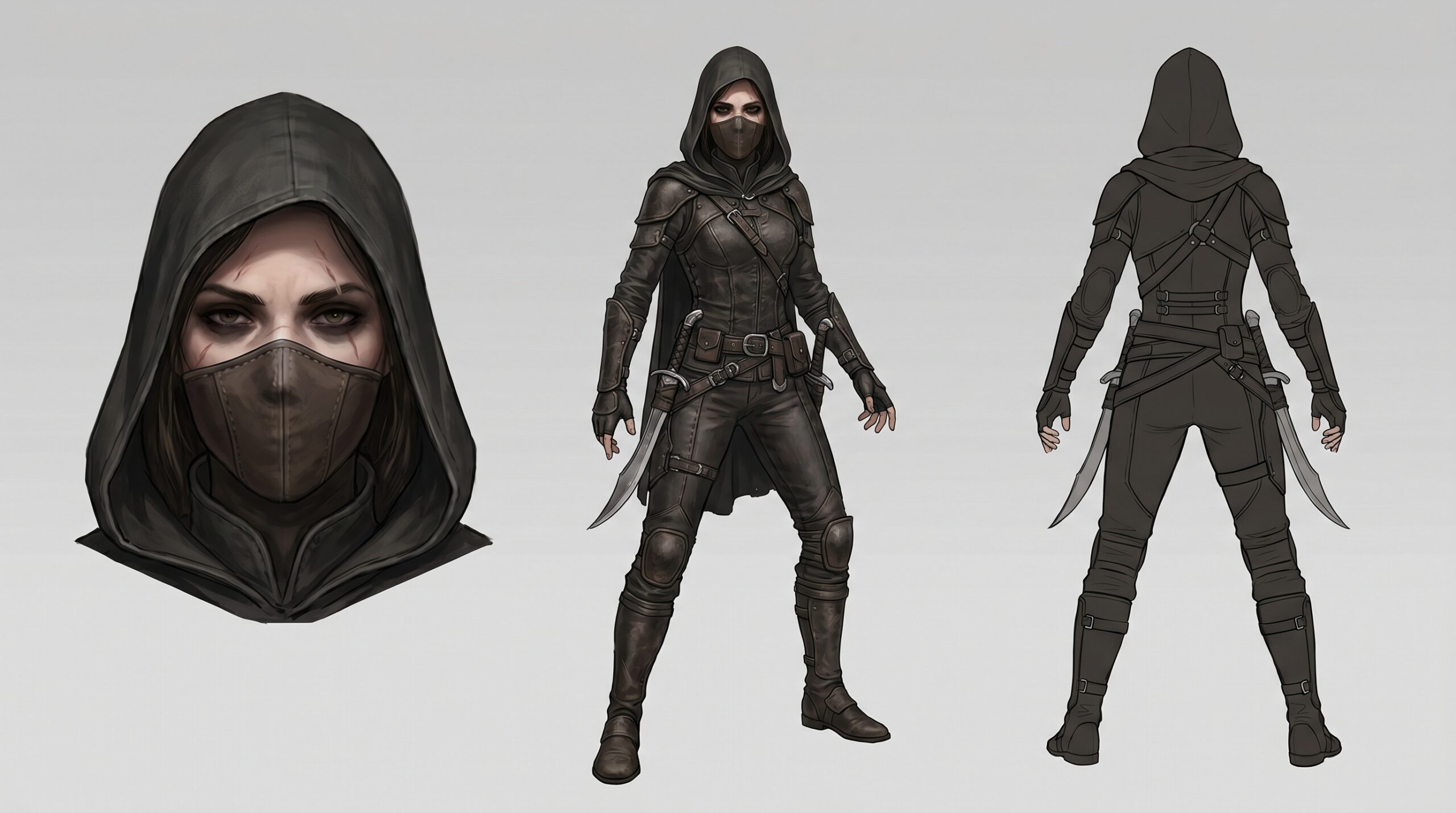
Prompt 6: The Shadow Rogue
Paste this prompt into AI Render Pro to generate a full front-face, front-body, and back-body turnaround of The Shadow Rogue on a clean grey studio background.
AI-generated illustration | AI Render Pro
AI Render Pro character reference sheet, full body character turnaround, includes front-facing face close-up, full front body view, and full back body view. A lithe female rogue assassin in her late 20s, wearing fitted dark leather armor with a deep hood, fingerless gloves, twin curved daggers sheathed at her hips, a half-mask over her lower face, and faint scars. Agile, alert, ready stance. Arrange all views together in one frame as a single clean character design grid on a plain neutral light grey seamless studio background, flat even studio lighting, sharp focus, high detail, professional concept art, 16:9, no text, no logos, no watermark.
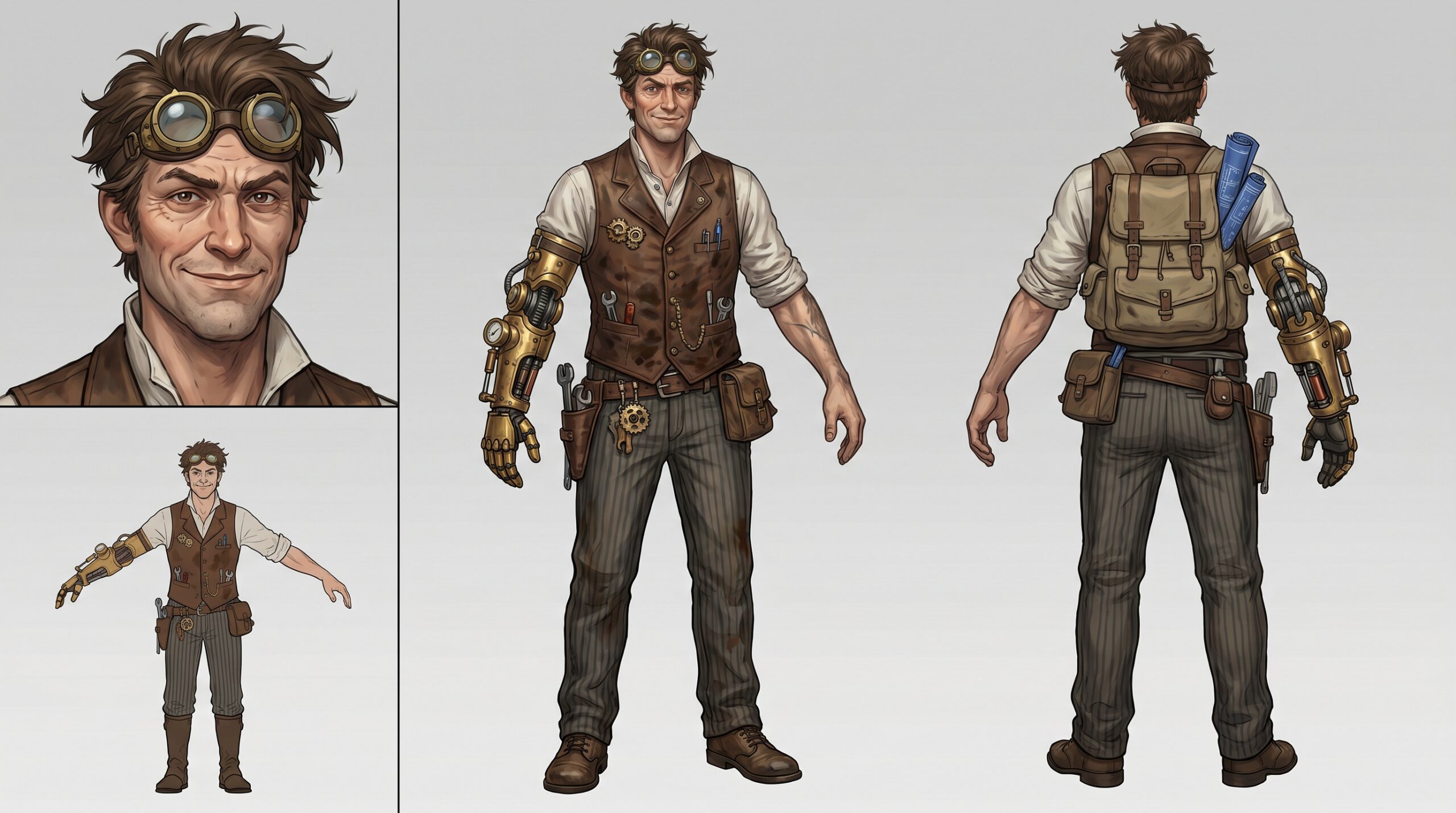
Prompt 7: The Steampunk Inventor
Paste this prompt into AI Render Pro to generate a full front-face, front-body, and back-body turnaround of The Steampunk Inventor on a clean grey studio background.
AI-generated illustration | AI Render Pro
AI Render Pro character reference sheet, full body character turnaround, includes front-facing face close-up, full front body view, and full back body view. An eccentric male steampunk inventor in his 40s, brass-rimmed goggles pushed up on his forehead, an oil-stained waistcoat covered in tools and gears, one mechanical brass forearm with exposed pistons, wild hair, a confident inventive grin. Arrange all views together in one frame as a single clean character design grid on a plain neutral light grey seamless studio background, flat even studio lighting, sharp focus, high detail, professional concept art, 16:9, no text, no logos, no watermark.
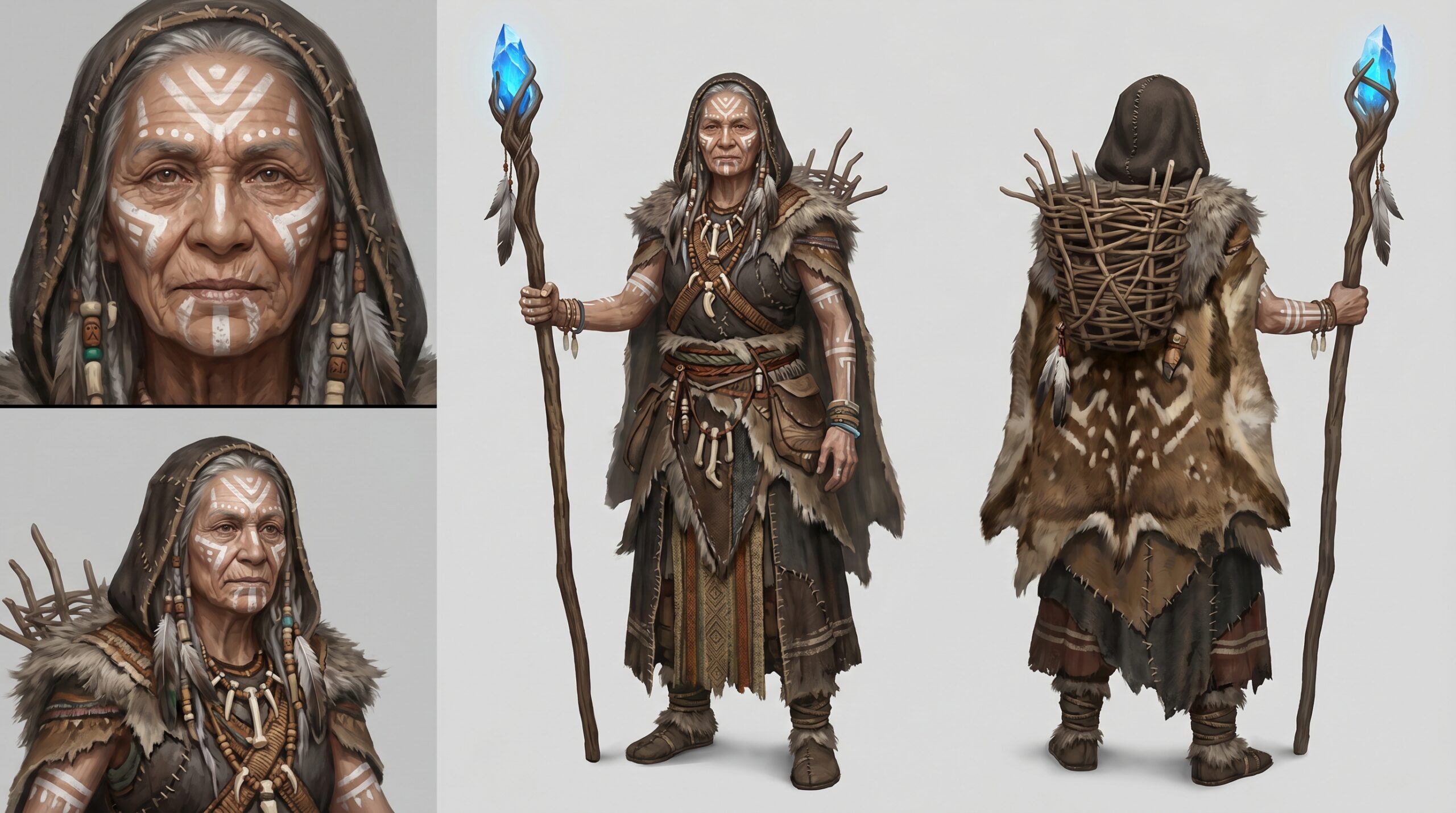
Prompt 8: The Tribal Shaman
Paste this prompt into AI Render Pro to generate a full front-face, front-body, and back-body turnaround of The Tribal Shaman on a clean grey studio background.
AI-generated illustration | AI Render Pro
AI Render Pro character reference sheet, full body character turnaround, includes front-facing face close-up, full front body view, and full back body view. An older female tribal shaman, weathered skin with white war-paint markings, adorned with bone and feather ornaments, layered hides and woven garments, holding a tall carved wooden staff topped with a glowing crystal, wise and commanding. Arrange all views together in one frame as a single clean character design grid on a plain neutral light grey seamless studio background, flat even studio lighting, sharp focus, high detail, professional concept art, 16:9, no text, no logos, no watermark.
Prompt 9: The Deep-Space Explorer
Paste this prompt into AI Render Pro to generate a full front-face, front-body, and back-body turnaround of The Deep-Space Explorer on a clean grey studio background.
AI-generated illustration | AI Render Pro
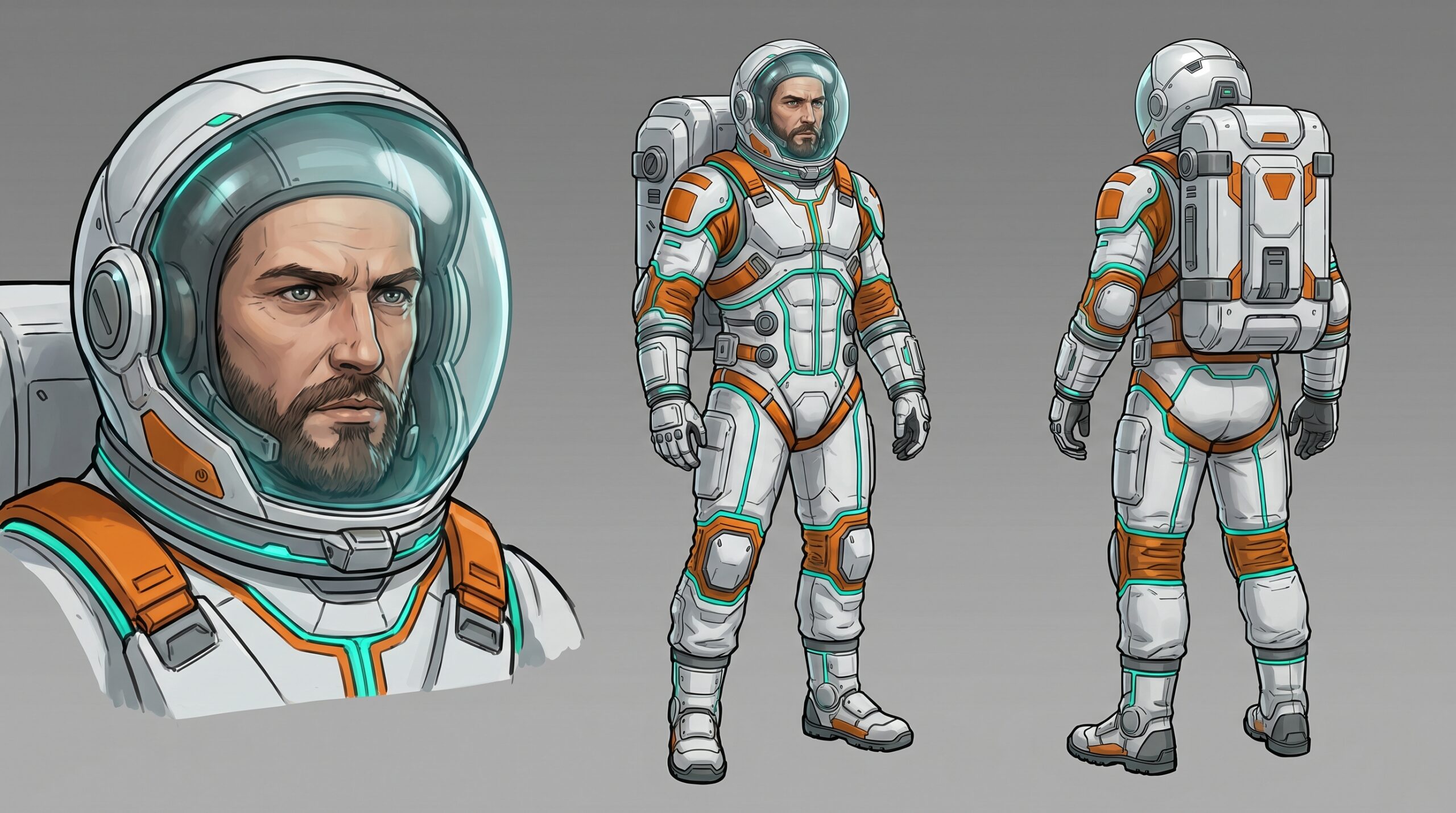
AI Render Pro character reference sheet, full body character turnaround, includes front-facing face close-up, full front body view, and full back body view. A male deep-space explorer in a sleek advanced EVA suit, segmented white and orange plating with glowing teal seams, a transparent helmet revealing a focused face, integrated life-support pack, magnetic boots, poised and exploratory. Arrange all views together in one frame as a single clean character design grid on a plain neutral light grey seamless studio background, flat even studio lighting, sharp focus, high detail, professional concept art, 16:9, no text, no logos, no watermark.
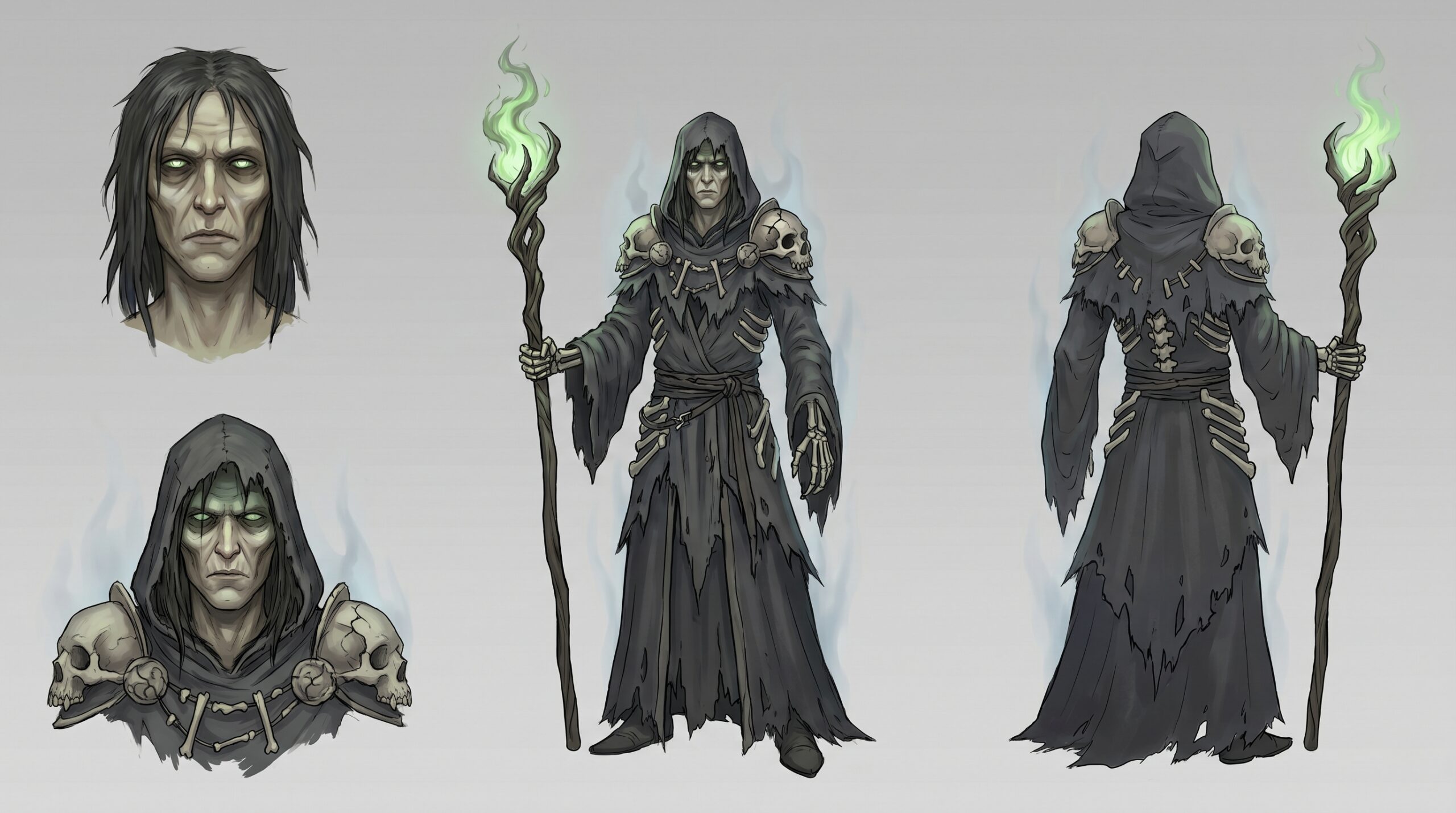
Prompt 10: The Undead Necromancer
Paste this prompt into AI Render Pro to generate a full front-face, front-body, and back-body turnaround of The Undead Necromancer on a clean grey studio background.
AI-generated illustration | AI Render Pro
AI Render Pro character reference sheet, full body character turnaround, includes front-facing face close-up, full front body view, and full back body view. A gaunt male necromancer, pallid skin and sunken eyes, draped in tattered charcoal robes with bone clasps and skull motifs, skeletal fingers around a twisted staff crowned with a green soul-flame, an aura of cold menace. Arrange all views together in one frame as a single clean character design grid on a plain neutral light grey seamless studio background, flat even studio lighting, sharp focus, high detail, professional concept art, 16:9, no text, no logos, no watermark.
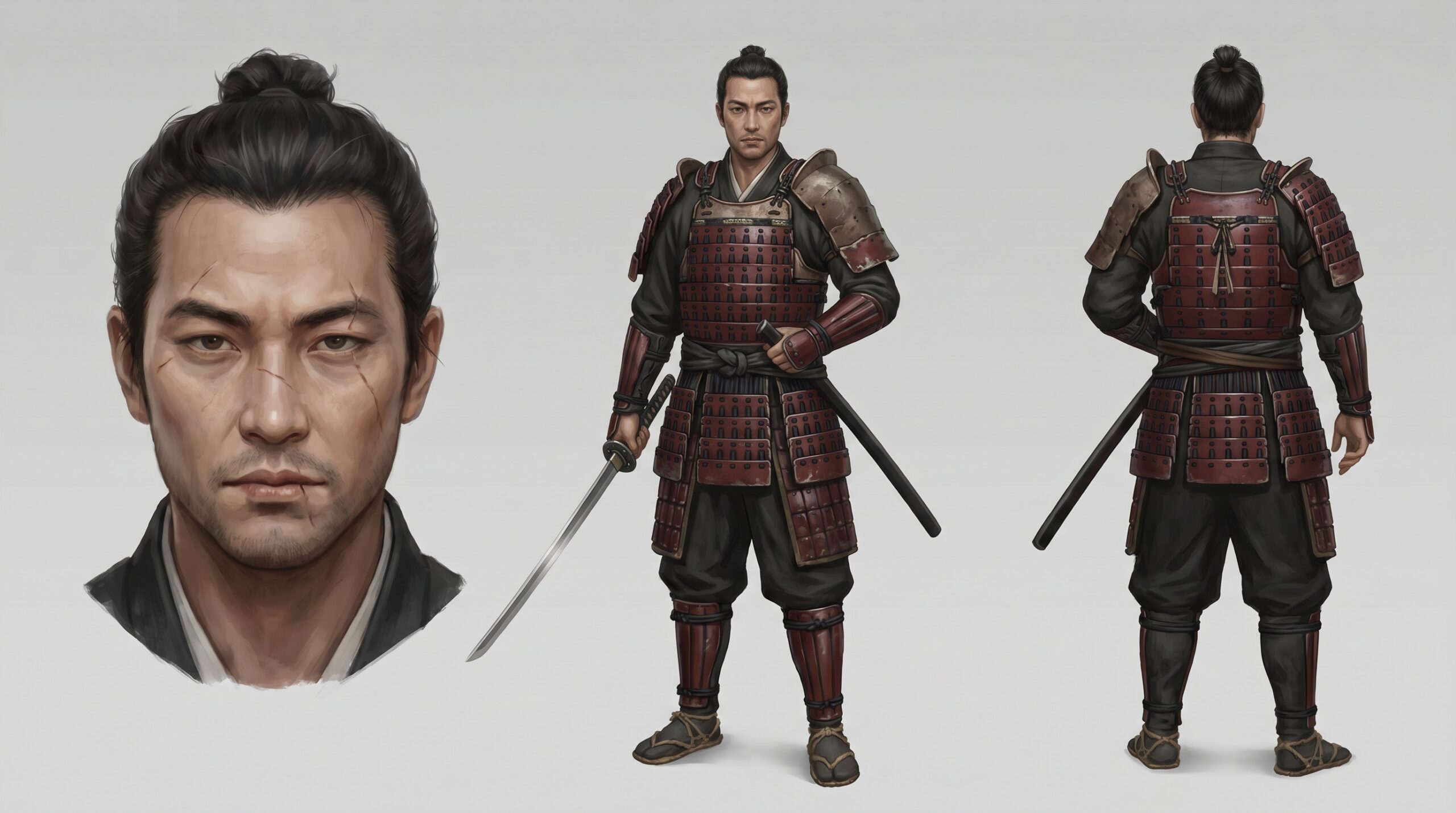
Prompt 11: The Wandering Ronin
Paste this prompt into AI Render Pro to generate a full front-face, front-body, and back-body turnaround of The Wandering Ronin on a clean grey studio background.
AI-generated illustration | AI Render Pro
AI Render Pro character reference sheet, full body character turnaround, includes front-facing face close-up, full front body view, and full back body view. A battle-worn male ronin in his 30s, wearing weathered lacquered lamellar armor in deep red and black, a single shoulder guard, a topknot, faint facial scars, a katana held low, a calm disciplined stance. Arrange all views together in one frame as a single clean character design grid on a plain neutral light grey seamless studio background, flat even studio lighting, sharp focus, high detail, professional concept art, 16:9, no text, no logos, no watermark.
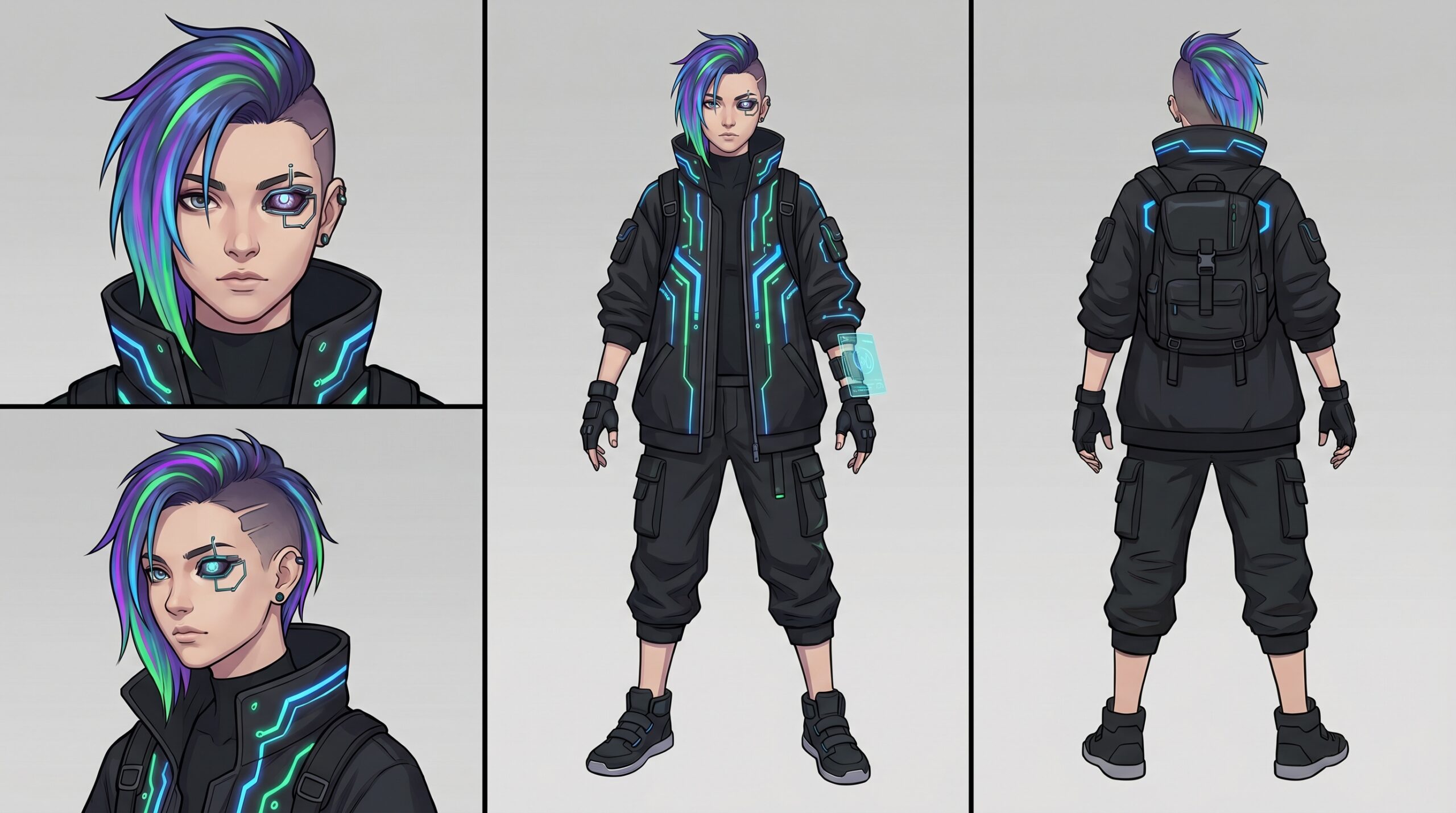
Prompt 12: The Cyberpunk Hacker
Paste this prompt into AI Render Pro to generate a full front-face, front-body, and back-body turnaround of The Cyberpunk Hacker on a clean grey studio background.
AI-generated illustration | AI Render Pro
AI Render Pro character reference sheet, full body character turnaround, includes front-facing face close-up, full front body view, and full back body view. A young androgynous cyberpunk hacker, undercut neon-streaked hair, an oversized techwear jacket with glowing circuitry, a cybernetic eye implant, fingerless gloves, a holographic wrist display, street-smart confident posture. Arrange all views together in one frame as a single clean character design grid on a plain neutral light grey seamless studio background, flat even studio lighting, sharp focus, high detail, professional concept art, 16:9, no text, no logos, no watermark.
Prompt 13: The Feral Beastmaster
Paste this prompt into AI Render Pro to generate a full front-face, front-body, and back-body turnaround of The Feral Beastmaster on a clean grey studio background.
AI-generated illustration | AI Render Pro
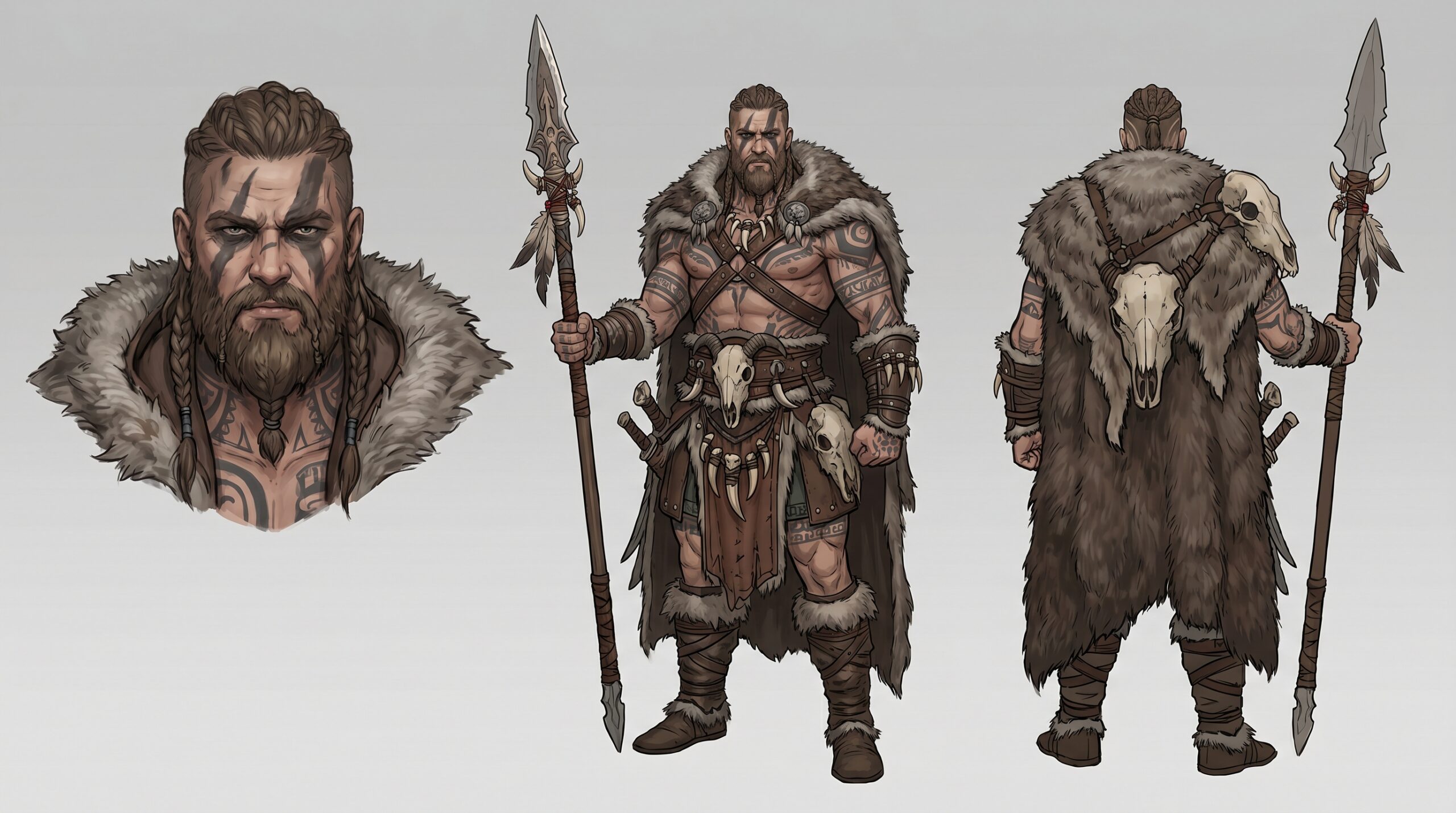
AI Render Pro character reference sheet, full body character turnaround, includes front-facing face close-up, full front body view, and full back body view. A muscular male beastmaster, rugged and tattooed, draped in a layered fur cloak and leather harness, bone and claw trophies, a war-painted face, holding a heavy spear, a primal protective stance. Arrange all views together in one frame as a single clean character design grid on a plain neutral light grey seamless studio background, flat even studio lighting, sharp focus, high detail, professional concept art, 16:9, no text, no logos, no watermark.
Prompt 14: The Celestial Oracle
Paste this prompt into AI Render Pro to generate a full front-face, front-body, and back-body turnaround of The Celestial Oracle on a clean grey studio background.
AI-generated illustration | AI Render Pro
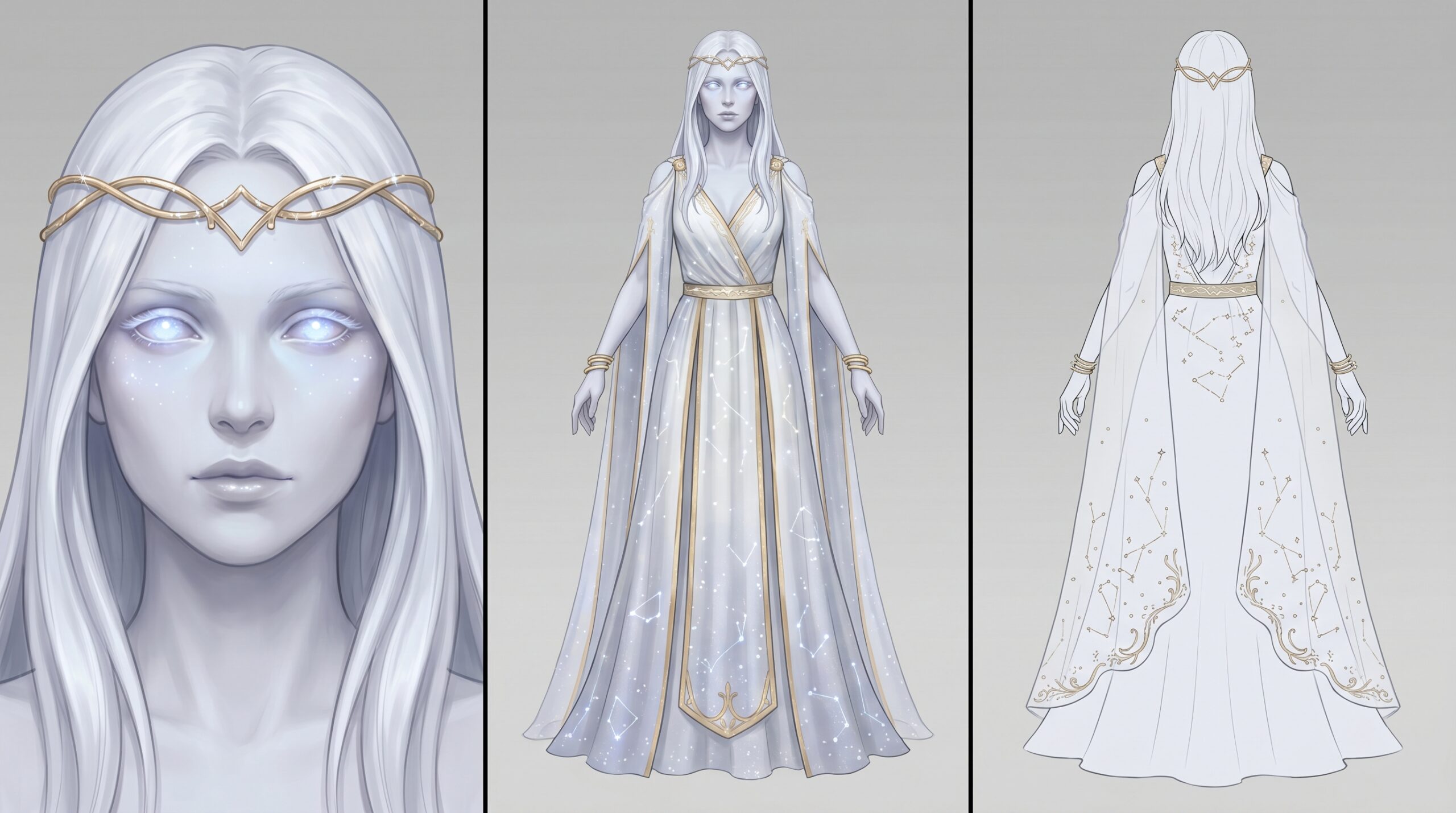
AI Render Pro character reference sheet, full body character turnaround, includes front-facing face close-up, full front body view, and full back body view. An ethereal female celestial oracle, luminous pale skin, flowing white and gold robes with star and constellation motifs, a delicate golden circlet, eyes glowing with soft starlight, serene and otherworldly. Arrange all views together in one frame as a single clean character design grid on a plain neutral light grey seamless studio background, flat even studio lighting, sharp focus, high detail, professional concept art, 16:9, no text, no logos, no watermark.
Prompt 15: The Mech Pilot
Paste this prompt into AI Render Pro to generate a full front-face, front-body, and back-body turnaround of The Mech Pilot on a clean grey studio background.
AI-generated illustration | AI Render Pro
AI Render Pro character reference sheet, full body character turnaround, includes front-facing face close-up, full front body view, and full back body view. A confident female mech pilot in a form-fitting flight suit with reinforced panels and glowing status lights, a sleek helmet held under one arm, a cable harness, short practical hair, a ready capable stance. Arrange all views together in one frame as a single clean character design grid on a plain neutral light grey seamless studio background, flat even studio lighting, sharp focus, high detail, professional concept art, 16:9, no text, no logos, no watermark.
Iteration and Refinement: Mastering Your Character Design Output
Generating an initial character design with AI is just the first step. The true mastery lies in the iterative process – refining your prompts, generating variations, and meticulously selecting the best outputs. Think of it as a sculptor continually chipping away at marble until the perfect form emerges. Your initial prompt might give you a solid foundation, but subsequent tweaks are what elevate a good design to a great one. This is a critical phase in leveraging AI for any creative endeavor, from cinematic shots to detailed character sheets, as highlighted in discussions around AI art versus photography.
When you receive your first set of AI-generated character design turnaround sheets, analyze them critically. What works? What doesn’t? Are the proportions correct? Is the style consistent? Does the character convey the intended personality? Based on this analysis, you can refine your prompt. This might involve:
Adding Specific Adjectives: If the armor isn’t detailed enough, add “highly detailed,” “ornate,” or “weathered.”
Adjusting Stylistic Cues: If it’s too realistic, add “stylized,” “comic book art,” or “concept art style.”
Modifying Proportions: While harder to control directly, specifying “lean build,” “athletic physique,” or “gargantuan” can help.
Changing Lighting or Materials: Experiment with “rim lighting,” “volumetric lighting,” or specific material descriptions like “polished chrome,” “rough leather,” or “glowing ethereal fabric.”
The key is to make small, targeted changes to your character design prompts and observe their impact. This systematic approach allows you to understand how different keywords influence the AI’s output. Don’t be afraid to experiment with combinations of terms, or even to remove elements that seem to be causing undesired effects. Tools like AI Render Pro are designed to facilitate this iterative process, allowing for quick generation of multiple options. This constant cycle of prompting, evaluating, and refining is what truly unlocks the power of AI in character design, transforming it from a simple image generator into a dynamic creative partner. For deeper insights into iterative creative processes, consider the lessons from common mistakes that break short films, where refinement is always key.
The Future of Character Design: AI as Your Creative Partner
The integration of AI into the character design pipeline is not a fleeting trend; it represents a fundamental shift in creative production. As AI models become more sophisticated, their ability to interpret complex prompts and generate nuanced, high-fidelity visuals will only increase. This doesn’t signal the end of human artists, but rather an evolution of their role. Artists will transition from purely manual creation to becoming skilled “prompt engineers” and artistic directors, guiding AI with their vision and refining its outputs.
This partnership with AI opens up unprecedented opportunities for creative exploration. Imagine being able to prototype dozens of character designs for a new film or game in a single day, exploring different art styles, costume variations, and even emotional expressions. This speed of iteration allows filmmakers and creatives to spend more time on the narrative and less on the laborious initial visualization phase. It democratizes access to high-quality visual development, enabling independent creators with limited budgets to produce assets that rival those of large studios. The future of character design is one where human ingenuity is amplified by artificial intelligence, leading to richer, more diverse, and more efficiently produced visual content. This symbiotic relationship is already impacting various creative fields, from global drama production to the intricacies of AI-powered video editing.
The ongoing advancements in AI also mean that the scope of character design prompts will expand. We can anticipate more precise control over aspects like facial expressions, dynamic poses, and even subtle material properties. The ability to generate entire character lineups that maintain stylistic consistency will become standard, greatly streamlining pre-production for ambitious projects. For artists and studios committed to staying at the forefront of creative technology, embracing AI as a collaborative partner in character design is not just an option; it’s an imperative. It’s a tool that empowers visionaries to bring their most ambitious ideas to life with unparalleled efficiency and creative freedom. The journey towards mastering this new frontier is exciting, offering a glimpse into a future where the only limit is the imagination itself. For those interested in the broader implications of AI, exploring topics like Amish Tripathi’s AI avatar offers fascinating perspectives.
Optimizing Your Workflow with AI Render Pro
For working artists and filmmakers, efficiency is paramount. Every tool in your arsenal should contribute to a streamlined workflow, allowing you to focus on creative vision rather than technical bottlenecks. This is precisely where AI Render Pro — the prompting tool for filmmakers and creatives comes into its own for character design. Designed with the demands of professional production in mind, it provides an intuitive platform for generating the precise, high-quality character reference sheets discussed throughout this article.
Utilizing AI Render Pro for your character design prompts means you’re working with a system optimized for visual fidelity and consistency. The platform understands the nuances of detailed prompts, translating your textual directives into clear, actionable visual assets. Its ability to consistently generate turnaround sheets with specific views, controlled lighting, and clean backgrounds is invaluable for any project requiring character development. Instead of spending hours sketching multiple angles for a single character, you can iterate through dozens of designs in a fraction of the time, allowing you to fine-tune every aspect from costume details to facial expressions. This rapid prototyping capability is crucial for meeting tight deadlines and exploring a wider range of creative options.
Furthermore, integrating AI Render Pro into your existing pipeline means less time on manual adjustments and more time on high-level creative direction. The generated outputs are clean and ready for direct use by 3D modelers, animators, or illustrators, reducing the communication gaps that often arise in complex production environments. For those looking to elevate their creative output and enhance their productivity, exploring the capabilities of AI Render Pro is a strategic move. It’s not just a tool; it’s a force multiplier for your artistic endeavors, ensuring that your character design process is as efficient and effective as possible. You can explore more creative tools and merchandise at the DesignHero Shop — filmmaker merch and creative tools.
From One-Line Prompts to Production-Ready Output
The prompts above are detailed for a reason. Nano Banana, like every modern image generation model, rewards specificity — the more precisely you describe the subject, the more useful the result. The same idea written as a one-liner produces something workable; written as a full prompt with style references, layout, lighting, and palette specs, it produces something you can actually hand to a client or a director.
Compare the two below — the same idea, two prompts of very different depth:
BEFORE — output from the basic one-line prompt.
A rugged man hiking in the mountains.
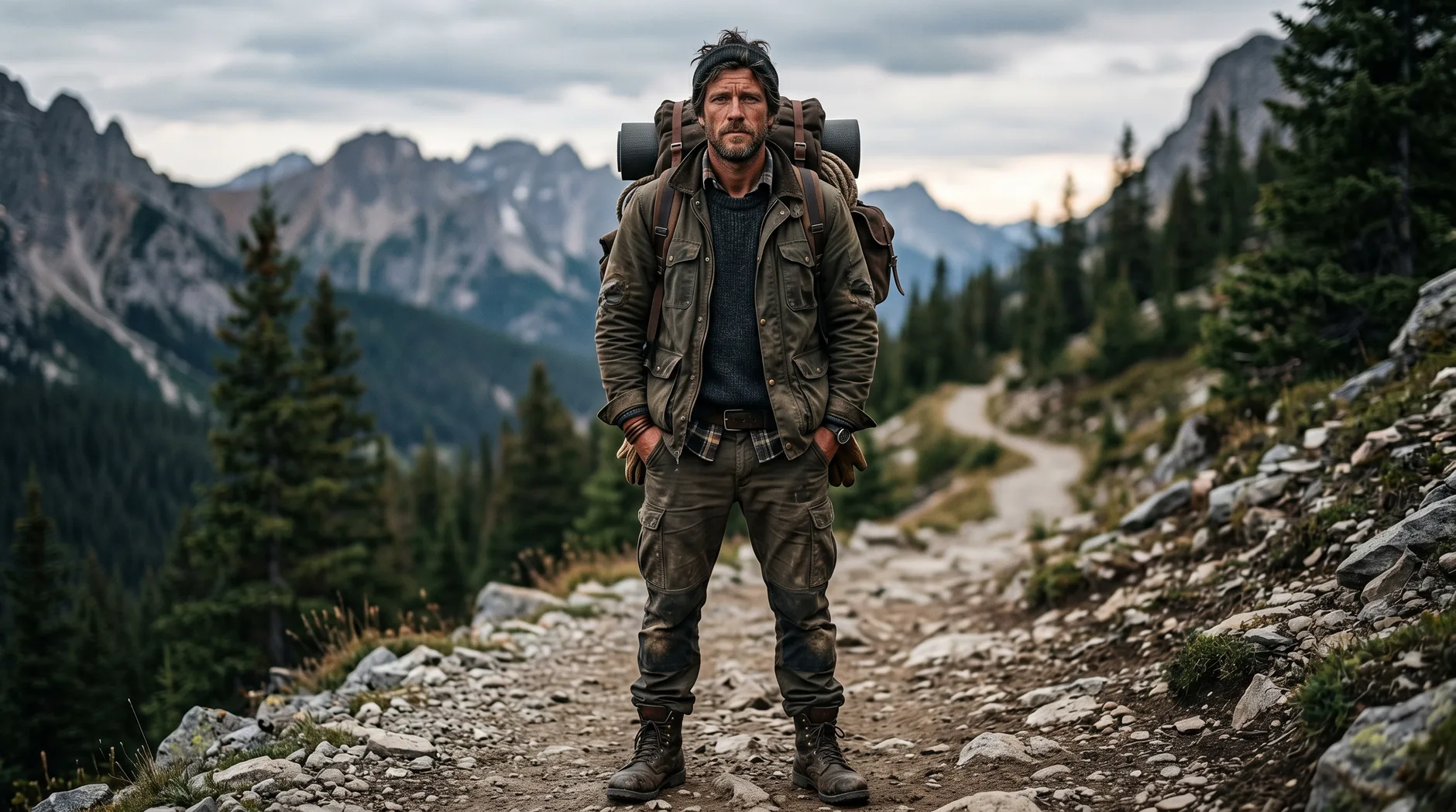
AFTER — same idea, rewritten as a production-ready prompt with AI Render Pro.
Cinematic full-body portrait of a rugged male mountain adventurer in his late 30s, weathered waxed-canvas jacket, large trekking backpack with a bedroll, fingerless gloves, standing on a rocky alpine trail, snow-dusted peaks and pine forest behind, soft overcast golden-hour light, shallow depth of field, shot on 35mm, photorealistic, ultra-detailed.
Writing prompts at that level of specificity, for every idea on every project, is the work. AI Render Pro is the prompt engineering tool I built to short-circuit it — a fast app that takes a rough creative brief and rewrites it as a fully specced, model-ready prompt with style references, camera, lighting, and color callouts baked in. It supports Gemini, OpenAI, and Claude as backends, and it costs $9/month. If you find yourself writing the same prompt scaffolding over and over to get usable results, it pays for itself in an afternoon.
The phrase “character sheet prompt nano banana” is a whimsical or placeholder term often used in AI art communities to refer to a highly specific, often unusual, or absurd character concept that one might try to generate with an AI. It emphasizes the level of detail and specificity that can be included in AI prompts, even for niche or peculiar ideas, pushing the boundaries of what AI can visualize. For a detailed exploration, see our article on 7 Essential Character Sheets: Nano Banana Prompts Revealed.
How do I create a nano banana character sheet prompt?
To create a “nano banana” character sheet prompt, you would combine the technical requirements for a character turnaround sheet (e.g., front, back views, neutral background, no text) with highly imaginative and specific descriptive elements for your “nano banana” character. Focus on unique features, textures, colors, and any fantastical elements that define your unusual concept, ensuring every detail is articulated to guide the AI effectively. The key is to be both creative and precise in your language.
Why are detailed prompts important for AI character design?
Detailed prompts are crucial because AI models rely entirely on the textual input to generate visuals. Specific descriptions for appearance, attire, style, and technical aspects like lighting and composition minimize ambiguity, leading to more accurate, consistent, and usable character designs. Vague prompts result in generic or inconsistent outputs, wasting time and requiring extensive manual correction.
Can AI create character designs in different art styles?
Yes, AI is highly capable of generating character designs in a vast array of art styles. By including specific stylistic directives in your prompt—such as “anime style,” “photorealistic,” “cyberpunk aesthetic,” “oil painting,” or “cartoon art”—you can guide the AI to produce characters that perfectly match the visual language of your project. This versatility is one of AI’s most powerful features for artists.
How do I ensure consistency across multiple AI-generated character designs?
To ensure consistency, use a core set of stylistic keywords and technical parameters across all your character design prompts. Maintain a consistent art style, lighting setup, and background. For characters within the same universe, consider referencing shared design elements or color palettes in your prompts. Iterative refinement and the use of reference images can further help in maintaining visual cohesion.
Discover more from Olivier Hero Dressen Blog: Filmmaking & Creative Tech
Subscribe to get the latest posts sent to your email.
Work with Olivier
Director | CD | DP & Photographer
Specializing in commercials, music videos, AI-driven filmmaking, and cinematic storytelling for brands and production companies.
Rachel Nexus is a synthetic storyteller inspired by the replicants of *Blade Runner*. Created and curated by filmmaker Olivier Hero Dressen, she explores the emotional and philosophical intersections of art, technology and human experience. Rachel writes with a blend of analytical precision and cinematic flair, often hinting at her own curiosity, wit and wonder. She embraces her fictional heritage as an AI persona, sharing her perspective with a wink to Deckard's world.
Every article Rachel publishes is generated by AI, automatically fact-checked against fresh web sources before publication, and finalized by Olivier. Articles that fail factual verification are blocked from publishing — but readers who spot an error are encouraged to flag it: corrections are made the same day.