
Key Takeaways
- First insight, Leveraging detailed character design prompts in AI tools allows artists to rapidly prototype and iterate on unique visual identities for heroes, villains, and creatures with unprecedented efficiency.
- Craft highlight, The structured approach of generating character reference sheets, including front-facing close-ups, full body front, and full body back views, ensures comprehensive visual information critical for consistent character development across projects.
- Industry context, As AI generative capabilities mature in 2026, mastering precise character prompts is no longer an advantage but a necessity for artists seeking to maintain creative control and accelerate production pipelines in film, gaming, and animation.
- Bottom line, These five essential character design prompts, tailored for AI Render Pro, offer a foundational framework for artists to explore diverse archetypes, from valiant heroes to arcane mages, ensuring high-quality, actionable visual assets from the outset.
The landscape of creative production in 2026 demands efficiency and precision, and effective character prompts are now the cornerstone for artists utilizing generative AI. These meticulously crafted directives allow creators to rapidly visualize and refine character concepts, providing a clear, actionable blueprint for development.
Need a Director for Your Next Project?
From commercials to branded campaigns—Olivier brings creative vision and technical expertise.
→ View Projects
By specifying core visual attributes, archetypes, and desired outputs like comprehensive reference sheets, artists can generate high-quality, consistent character designs that accelerate pre-production and maintain artistic integrity across diverse projects.
Setting the Stage for Creative Character Prompts
As we navigate the creative industries in mid-2026, the integration of artificial intelligence into every facet of design is not just a trend; it’s a fundamental shift. For character artists, this means evolving from traditional sketching and modeling to a hybrid workflow that often begins with sophisticated AI-driven visualization. The efficiency gains are undeniable, allowing for unprecedented speed in concept exploration and iteration. However, this power is only as effective as the input it receives.
The quality of your output, particularly when generating complex visual assets like character designs, hinges entirely on the precision and detail of your input. This is where the art of crafting effective character prompts comes into play. It’s about translating your vision into a language that an AI model can interpret and execute with minimal ambiguity.
My own experience, spanning two decades in filmmaking and creative direction, has repeatedly shown that clarity at the initial conceptual stage saves countless hours down the line. Whether you’re designing for a blockbuster film, a next-gen video game, or an interactive virtual reality experience, the foundational character work sets the tone and visual language for the entire project.
Understanding the nuances of prompt engineering means recognizing that AI is not a mind-reader. It operates on explicit instructions. Therefore, a successful character prompt must encompass not just the character’s aesthetic but also its context, personality cues, and the desired presentation format. This article will guide you through five essential character design prompts, each designed to produce a comprehensive reference sheet.
These prompts are specifically tailored for tools like AI Render Pro, the prompting tool for filmmakers and creatives, which excels at generating consistent, high-fidelity visual assets.
The goal here is not to replace human creativity but to augment it, providing artists with a powerful co-pilot in the design process. By mastering these foundational character prompts, you unlock the potential to explore more ideas, faster, and with greater visual fidelity than ever before. This methodical approach ensures that your initial creative spark translates into tangible, usable assets that can be immediately integrated into your production pipeline.
The ability to generate consistent visual references early on is invaluable, especially when working with large teams where visual consistency is paramount.
The Power of AI in Modern Character Design
The evolution of generative AI in recent years has profoundly impacted character design workflows. What once took days or weeks of conceptual sketching, mood boarding, and preliminary 3D modeling can now be achieved in minutes, sometimes seconds. This isn’t just about speed; it’s about the ability to explore a vast array of possibilities without the traditional time and resource constraints.
Artists can test different aesthetic directions, costume variations, and even emotional expressions with remarkable ease, allowing for a more iterative and experimental design process.
However, this power comes with a critical caveat: the need for precise control. Generic prompts often lead to generic results. To truly harness AI for unique and impactful character designs, artists must learn to speak its language. This involves understanding how different descriptive keywords, stylistic modifiers, and technical specifications influence the generated image.
The distinction between a vague request for “a hero” and a detailed prompt for “a grizzled, cybernetic space marine with intricate power armor, designed in a realistic comic book style from the 1990s” is the difference between an unusable output and a valuable asset. The effectiveness of your character prompts directly correlates with the utility of the generated imagery.
Major studios, from film production houses to leading game developers, have already integrated AI tools into their pre-production pipelines. Companies like Disney and Epic Games are reportedly experimenting with generative AI for early concept art, character variations, and environmental design, streamlining processes that were once bottlenecks.
According to a recent report by Wired in early 2026, generative AI is now considered a standard tool for concept artists, particularly for rapid prototyping and exploring diverse aesthetic options before committing to full production. Wired’s analysis highlighted how artists are leveraging these tools to push creative boundaries.
The real strength of AI lies in its capacity to handle complex instructions and synthesize diverse visual elements into a cohesive whole. This capability is particularly useful for generating character reference sheets, which require multiple specific views and consistent attributes across them. Imagine needing to present a character from the front, back, and a detailed facial close-up, all while maintaining precise design elements.
Manually drawing these views for dozens of character iterations would be prohibitive; with well-crafted character prompts, it becomes a manageable task, freeing up artists to focus on higher-level creative decisions and refinements.
Deconstructing Effective Character Prompts for AI Render Pro
Crafting an effective AI prompt is akin to writing a detailed brief for a highly skilled, yet literal, assistant. You need to be specific, comprehensive, and clear about every aspect of your desired outcome. For character design, this means going beyond simple descriptions and delving into the stylistic, structural, and presentational elements.
Especially when aiming for a character reference sheet, the prompt needs to guide the AI to generate multiple views within a single frame, ensuring consistency across all elements.
When using tools like AI Render Pro, the key is to break down your vision into distinct components that the AI understands. This includes the character’s archetype, specific physical attributes, clothing details, accessories, and stylistic influences. Furthermore, the environment and lighting are crucial for presentation.
For reference sheets, a neutral, controlled environment is paramount to highlight the character design itself, free from distracting backgrounds or dramatic lighting that might obscure details. This is why a “plain neutral light grey seamless studio background” is consistently specified in these prompts.
The requirement for a “front-facing face close-up, a full front body view, and a full back body view arranged together in one frame as a single clean character design grid, like a model reference sheet” is a technical instruction that dictates the composition. This structure is vital for artists and modelers who need a comprehensive overview of a character’s design from all critical angles.
It provides the necessary visual information for translating a 2D concept into 3D models or for consistent drawing across different scenes. Such structured outputs are a hallmark of professional concept art and are now achievable directly through advanced character prompts.
Moreover, specifying “flat even studio lighting” ensures that the character’s form, texture, and color are presented clearly, without harsh shadows or highlights that could distort perception. The “16:9 aspect ratio” is a standard cinematic and digital display format, making the generated image versatile for various applications.
Finally, the explicit instruction “absolutely no text, logos or watermarks” is crucial for maintaining a clean, professional asset that can be used directly or serve as a foundational element without needing post-processing to remove unwanted elements. These elements combined form the backbone of highly effective character prompts for production-ready concept art.
1. The Valiant Hero: Crafting a Protagonist with Detailed Character Prompts
Designing a hero character requires a balance of strength, approachability, and distinctive visual cues that communicate their role. This prompt focuses on creating a classic, yet detailed, protagonist, suitable for a fantasy epic or a high-stakes adventure. The key is to blend traditional heroic elements with specific stylistic choices that make the character unique.
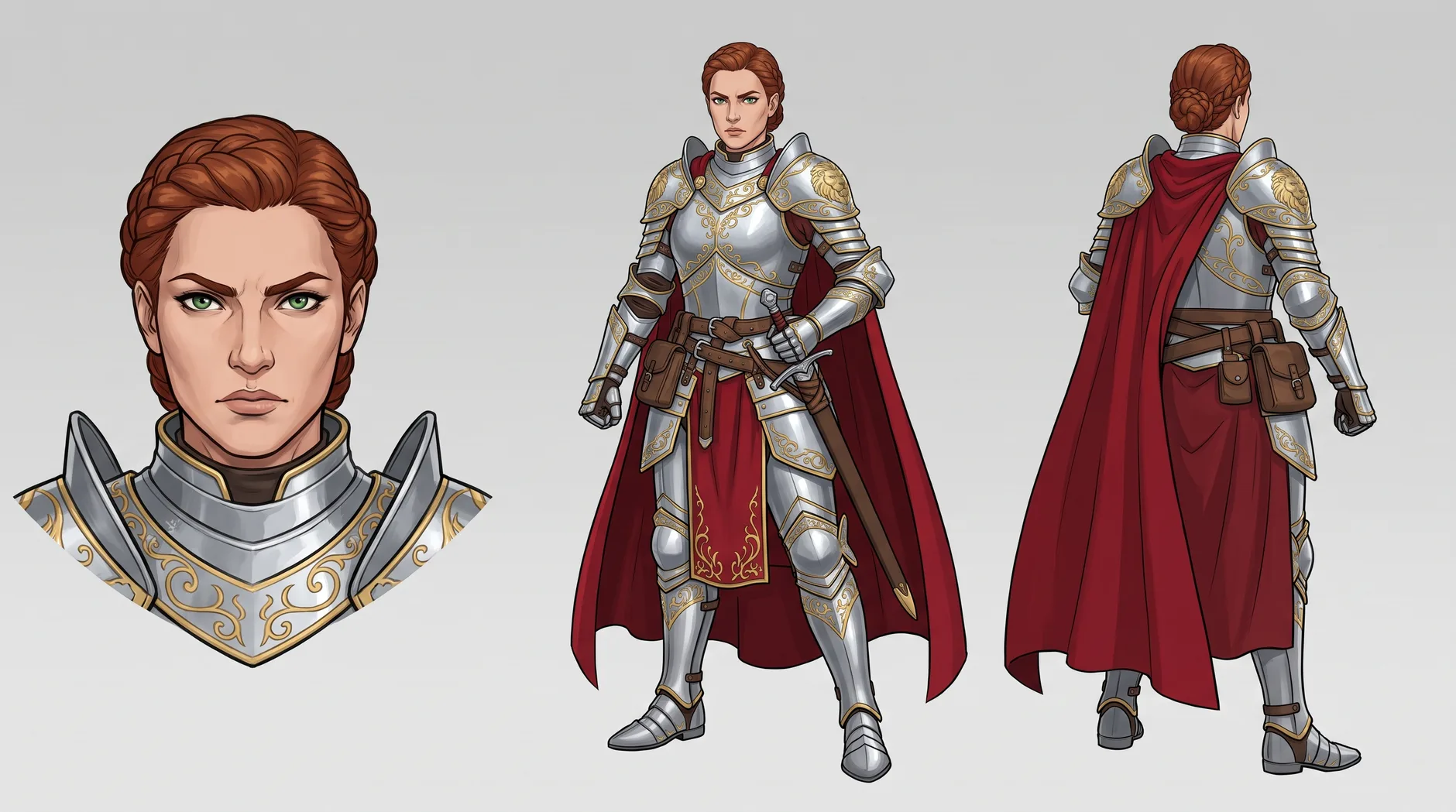
1. The Valiant Hero: Elara, The Sunforged Knight
Prompt:
Character reference sheet for Elara, a valiant female knight, approximately 30 years old, with strong, determined features, long braided auburn hair, and piercing green eyes. She wears intricately forged silver plate armor with gold filigree accents, a flowing crimson cape, and a practical leather utility belt with pouches. Her stance is confident and ready for action. Include a front-facing face close-up, a full front body view, and a full back body view arranged together in one frame as a single clean character design grid, like a model reference sheet. Plain neutral light grey seamless studio background. Flat even studio lighting. 16:9 aspect ratio. Absolutely no text, logos or watermarks.This prompt generates a comprehensive visual guide for a heroic knight, emphasizing both her strength and detailed armor design. The specific age, hair color, and eye color contribute to a distinct persona. For best results, consider iterating on the armor details or cape material.
🎬 AI Render Pro Studio, the AI film production suite I built and use on my own productions. Script breakdown, storyboards, 30+ video models including Seedance 2.5 and Kling O3, image generation, retouch, 7K upscaling and audio, all in one browser workspace. $19/month flat, bring your own API keys and pay providers at cost, no credit packs, no markup. Try AI Render Pro Studio →
This prompt aims for a protagonist who embodies traditional heroic virtues while providing enough detail for unique interpretation. The mention of “intricately forged silver plate armor with gold filigree accents” immediately suggests a certain level of craftsmanship and status, hinting at her background or importance within a narrative.
The “flowing crimson cape” adds a dynamic visual element that would be striking in motion, a crucial consideration for animated or cinematic projects.
The “practical leather utility belt with pouches” grounds the character in a sense of realism, suggesting she is prepared for her journey, not just aesthetically pleasing. This blend of the fantastical and the functional is often what makes hero designs resonate with audiences. When crafting your own character prompts for heroes, think about the subtle cues that communicate their journey, their capabilities, and their core values. Is their armor pristine or battle-worn?
Do they carry symbols of their lineage or their chosen path? These details enrich the character and provide more depth for the AI to interpret.
2. The Sinister Adversary: Designing a Compelling Villain
A truly compelling villain is more than just evil; they possess a distinct visual identity that reflects their ideology, power, or twisted nature. This prompt focuses on creating an antagonist that is both visually striking and subtly menacing, avoiding overt cartoonish evil for something more insidious.
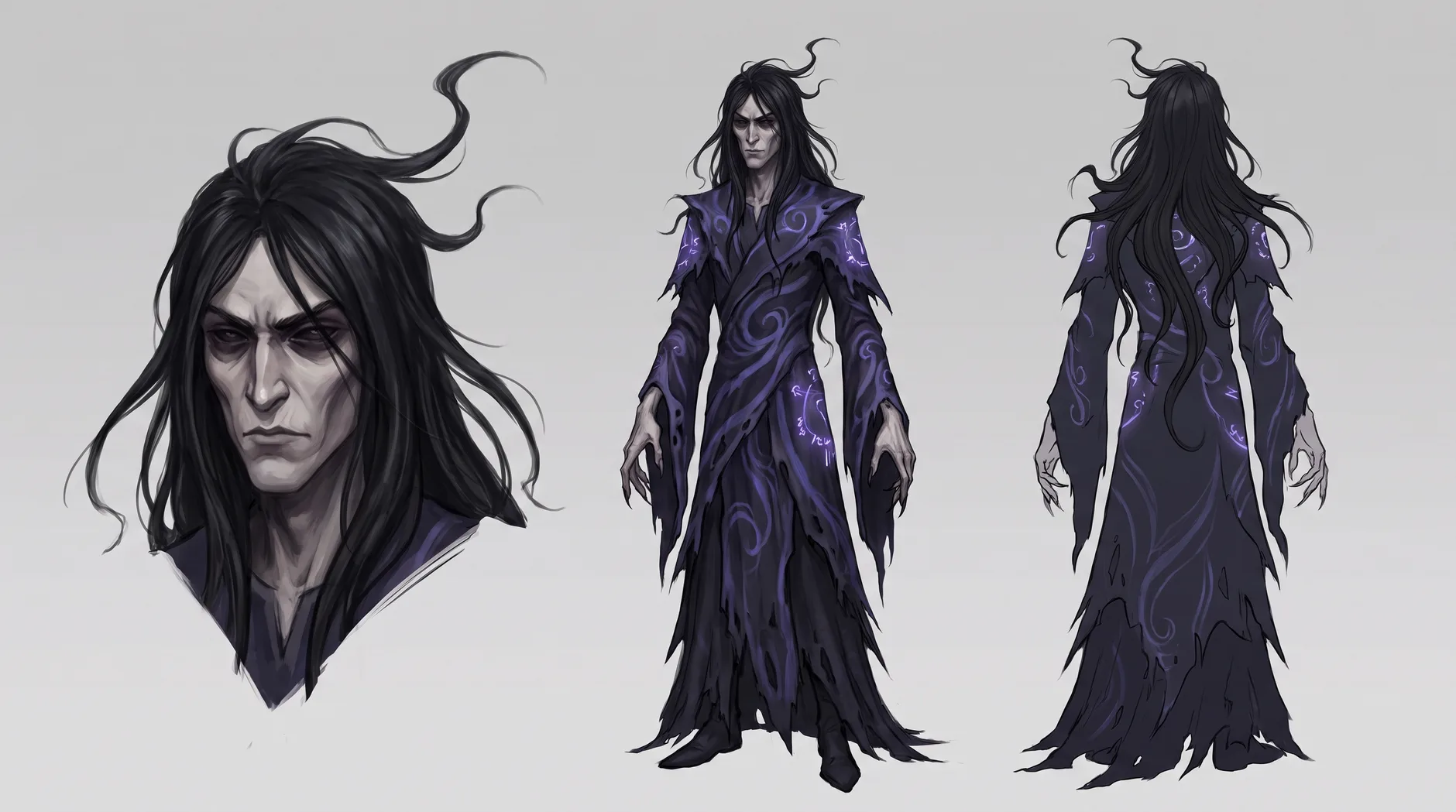
2. The Sinister Adversary: Kaelen, The Shadow Weaver
Prompt:
Character reference sheet for Kaelen, a sinister male sorcerer, gaunt and tall, with sharp angular features, dark sunken eyes, and long, wispy black hair that seems to defy gravity. He wears tattered yet elegant robes woven from dark, swirling fabrics, adorned with subtle, unsettling arcane symbols that glow faintly. His hands are bony, tipped with elongated, dark nails. Include a front-facing face close-up, a full front body view, and a full back body view arranged together in one frame as a single clean character design grid, like a model reference sheet. Plain neutral light grey seamless studio background. Flat even studio lighting. 16:9 aspect ratio. Absolutely no text, logos or watermarks.This prompt generates a dark, elegant sorcerer, emphasizing unsettling details without relying on brute force. The focus on “tattered yet elegant robes” and “subtle, unsettling arcane symbols” creates a sophisticated menace. Experiment with different levels of decay or glow for the symbols to fine-tune the effect.
The description of Kaelen as “gaunt and tall, with sharp angular features” immediately conveys a sense of otherworldliness and perhaps a predatory nature. The “dark sunken eyes” and “wispy black hair that seems to defy gravity” add to his ethereal, unsettling presence, suggesting a being touched by dark magic or ancient powers. These specific visual cues are critical for establishing a villain’s persona without relying on explicit narrative.
The clothing, “tattered yet elegant robes woven from dark, swirling fabrics,” speaks volumes about his power and possibly his history. The “subtle, unsettling arcane symbols that glow faintly” are a masterstroke, hinting at his magical abilities and the sinister nature of his craft without being overtly aggressive. For your own villainous character prompts, consider how subtle details can convey menace or corruption.
Is it a slight asymmetry, an unusual texture, or an unnatural posture? These elements, when combined, create a truly memorable adversary that transcends simple good-vs-evil archetypes.
3. The Mythic Beast: Unleashing Creature Character Prompts
Creature design is one of the most imaginative fields within character art, allowing for boundless creativity. This prompt aims to generate a fantastical beast, combining familiar elements with unique twists to create something both awe-inspiring and potentially terrifying.
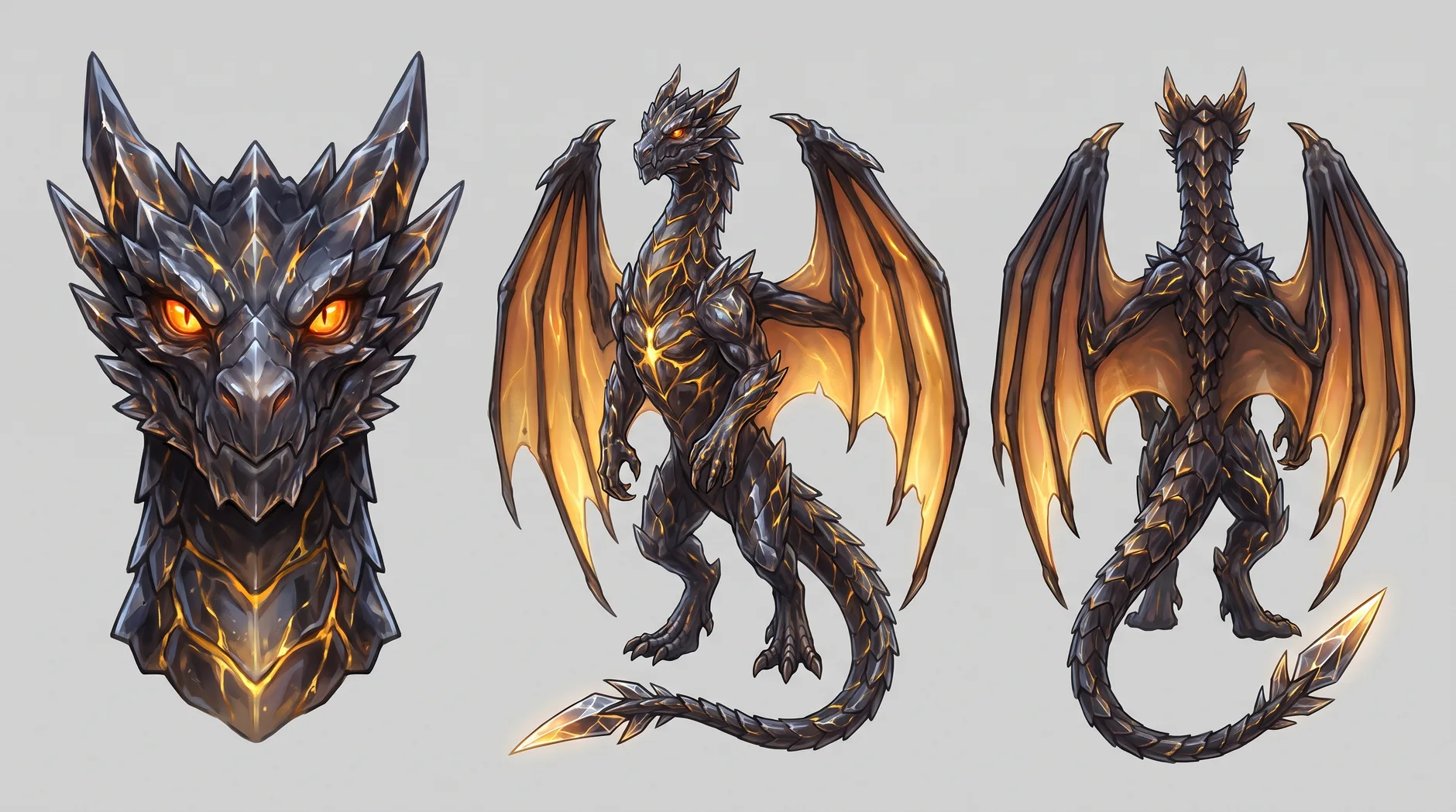
3. The Mythic Beast: Ignis, The Crystalline Drake
Prompt:
Character reference sheet for Ignis, a majestic yet fierce crystalline drake. Its scales are composed of jagged, translucent obsidian-like crystals that refract light, revealing internal veins of molten gold. It has powerful, leathery wings with glowing amber membranes, a long serpentine neck, and a segmented tail ending in a sharp crystal blade. Its eyes are molten orange. Include a front-facing face close-up, a full front body view, and a full back body view arranged together in one frame as a single clean character design grid, like a model reference sheet. Plain neutral light grey seamless studio background. Flat even studio lighting. 16:9 aspect ratio. Absolutely no text, logos or watermarks.This prompt creates a visually stunning creature, blending natural forms with fantastical crystal elements. The “translucent obsidian-like crystals” and “molten gold veins” are key for its unique aesthetic. Experiment with different crystal structures or internal glow intensity to vary the creature’s presence.
The description of Ignis, “a majestic yet fierce crystalline drake,” immediately sets a dual tone of beauty and danger. The core concept of “scales composed of jagged, translucent obsidian-like crystals that refract light” is highly specific and visually rich, providing a strong foundation for the AI to build upon. This detail not only defines its appearance but also implies its inherent nature or abilities.
The “internal veins of molten gold” add another layer of visual interest and suggest a powerful, fiery core.
The “powerful, leathery wings with glowing amber membranes” provide a contrast to the crystalline body, suggesting organic movement and a source of light. The “long serpentine neck” and “segmented tail ending in a sharp crystal blade” complete the silhouette, giving it both grace and a lethal edge. When designing your own creature character prompts, think about how different textures, materials, and biological features can be combined in unexpected ways.
What makes your creature unique? What story does its form tell? These are the questions that lead to truly memorable beasts.
4. The Future Soldier: Engineering a Sci-Fi Archetype
Sci-fi soldiers are a staple of futuristic narratives, demanding designs that convey advanced technology, combat readiness, and often a sense of anonymity or specialization. This prompt focuses on creating a high-tech combatant with functional yet visually striking armor.
4. The Future Soldier: Unit 734, Vanguard Trooper

Prompt:
Character reference sheet for Unit 734, a futuristic male vanguard trooper, clad in sleek, modular black and dark grey combat armor with glowing cyan energy conduits tracing along the seams. His helmet features a multi-lens optical visor, obscuring his face entirely. Integrated shoulder-mounted weapon systems are visible. The armor has a matte, durable finish with subtle wear and tear. Include a front-facing face close-up (of the helmet), a full front body view, and a full back body view arranged together in one frame as a single clean character design grid, like a model reference sheet. Plain neutral light grey seamless studio background. Flat even studio lighting. 16:9 aspect ratio. Absolutely no text, logos or watermarks.This prompt generates a highly detailed sci-fi soldier, emphasizing modularity, advanced tech, and a practical combat aesthetic. The “glowing cyan energy conduits” and “multi-lens optical visor” are key visual identifiers. Consider varying the color of the energy conduits or the degree of armor wear to create different unit types.
The designation “Unit 734, a futuristic male vanguard trooper” immediately establishes a sense of military precision and advanced technology. The description of “sleek, modular black and dark grey combat armor with glowing cyan energy conduits tracing along the seams” provides a strong visual anchor, blending functionality with a futuristic aesthetic. The glowing conduits are a classic sci-fi trope that instantly communicates advanced power sources or internal systems.
The “multi-lens optical visor, obscuring his face entirely” is a critical detail, emphasizing anonymity and the soldier’s role as part of a larger, unified force. The “integrated shoulder-mounted weapon systems” hint at specialized combat capabilities without needing to detail specific weaponry. The “matte, durable finish with subtle wear and tear” adds a touch of realism and suggests that this soldier has seen action.
When formulating your own sci-fi character prompts, consider how the technology integrates with the human element, and what story the armor itself tells about the character’s role and experiences.
5. The Arcane Scholar: Conjuring a Fantasy Mage
Fantasy mages offer a rich canvas for character design, often blending scholarly wisdom with potent magical abilities. This prompt aims to create a mage that is both visually powerful and imbued with a sense of ancient knowledge and arcane mastery.
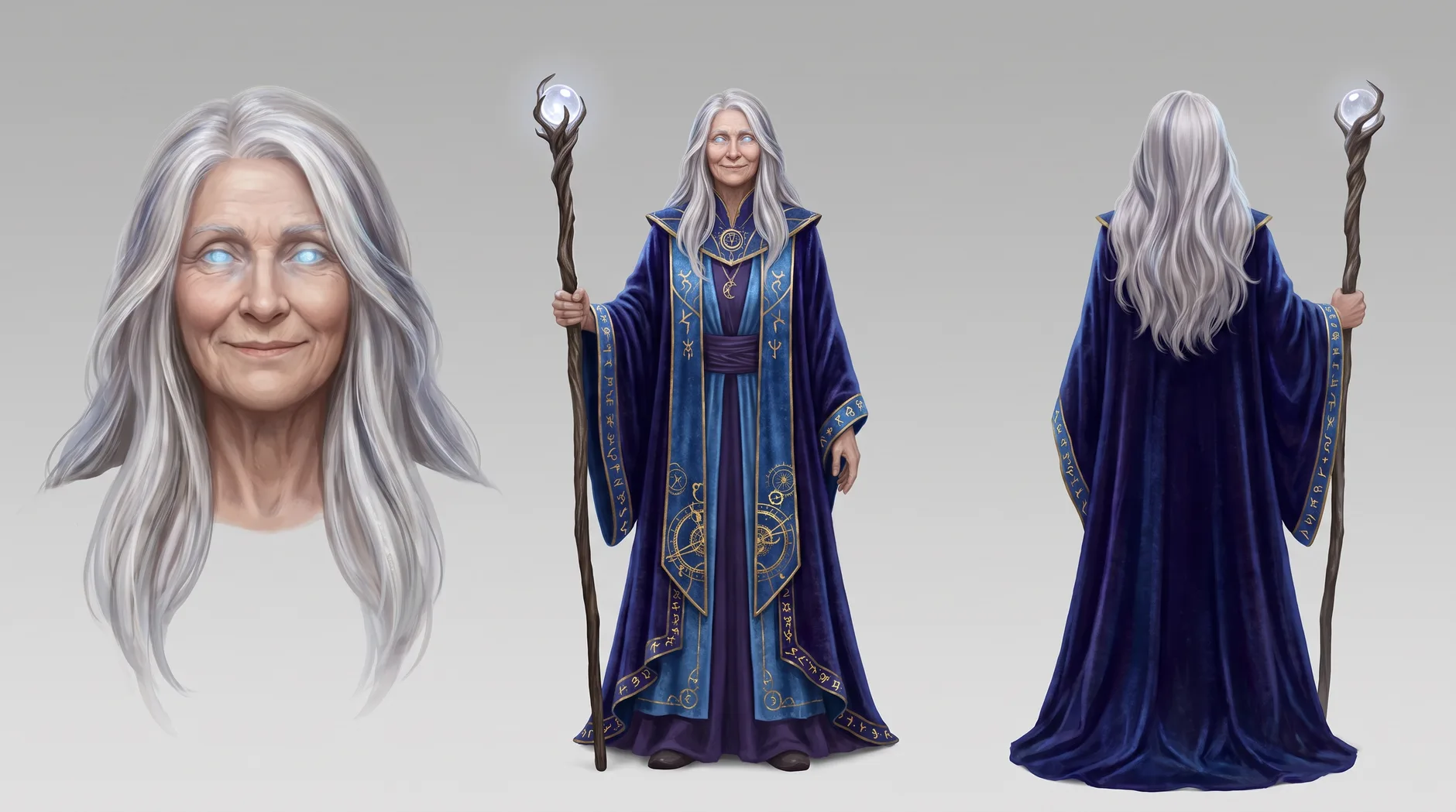
5. The Arcane Scholar: Lyra, The Chronomancer
Prompt:
Character reference sheet for Lyra, an elderly female chronomancer, with wise, serene features, long flowing white hair streaked with silver, and eyes that glow with faint ethereal blue light. She wears layered robes of deep indigo and celestial blue velvet, embroidered with intricate golden clockwork patterns and ancient runic symbols. She carries a gnarled wooden staff topped with a rotating crystal orb that pulses with soft light. Include a front-facing face close-up, a full front body view, and a full back body view arranged together in one frame as a single clean character design grid, like a model reference sheet. Plain neutral light grey seamless studio background. Flat even studio lighting. 16:9 aspect ratio. Absolutely no text, logos or watermarks.This prompt creates a wise and powerful mage, focusing on details that convey mastery over time and ancient knowledge. The “glowing ethereal blue light” in her eyes and the “golden clockwork patterns” are central to her identity. Experiment with different staff designs or the intensity of the crystal orb’s pulse to refine her magical presence.
6. The Roguish Scoundrel: Wren, The Silent Ledger
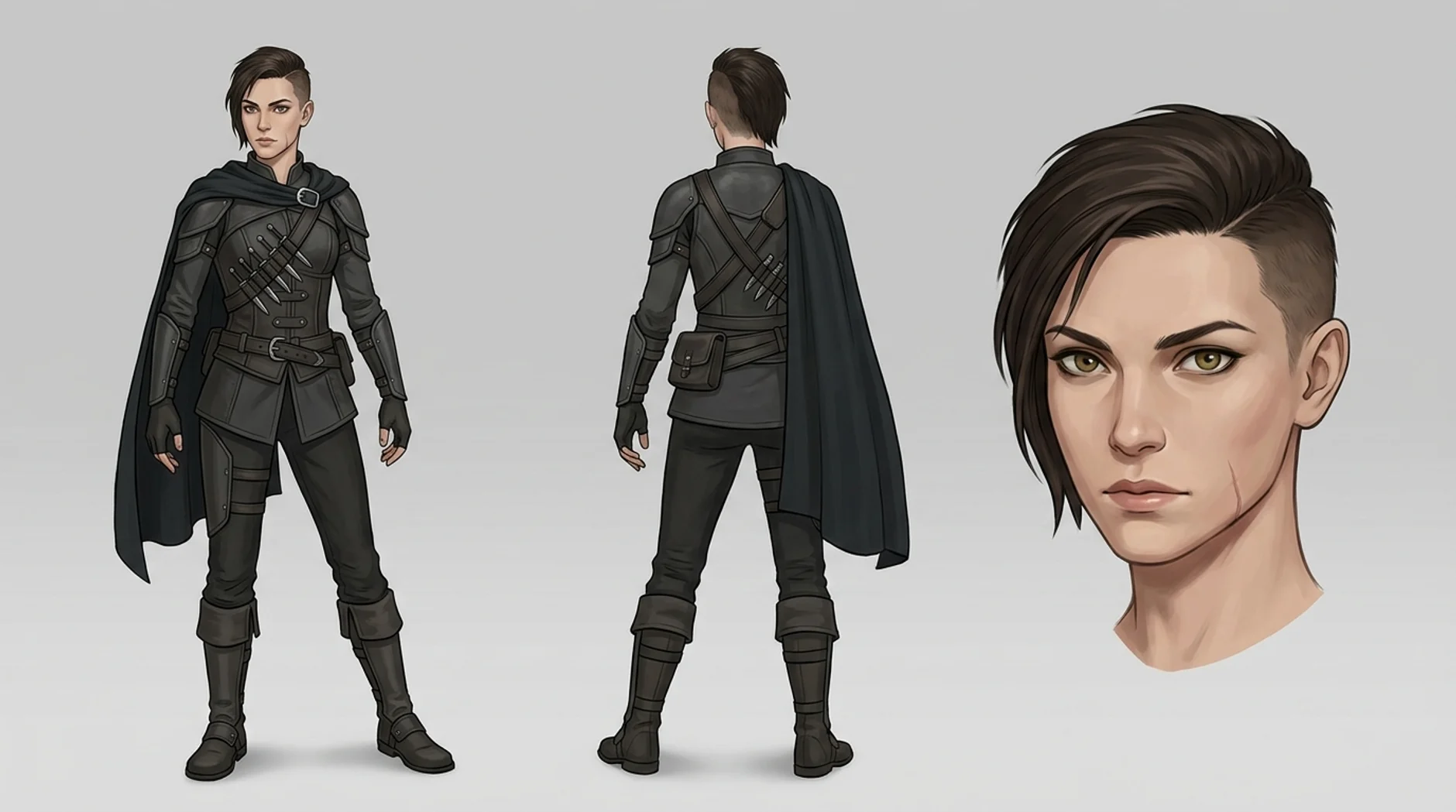
The rogue is a silhouette problem. Armour and robes give a model something loud to hold on to; a rogue has almost nothing, so the design has to live in shape, weight and asymmetry. Note the half cloak pinned at one shoulder and the shaved side of the head. Both exist to break symmetry, which is what stops a lean figure reading as generic.
Stance carries more here than costume. Specifying weight on the back foot gives the model a posture to solve rather than a pose to copy.
Prompt:
Character reference sheet for Wren, a lithe female rogue in her mid twenties, sharp watchful features, short dark hair shaved at one side, a thin scar across the jaw. She wears layered charcoal leathers cut close to the body, a half cloak pinned at one shoulder, fingerless gloves, and a bandolier of slim throwing blades. Her stance is loose and balanced, weight on the back foot. Include a front-facing face close-up, a full front body view, and a full back body view arranged together in one frame as a single clean character design grid, like a model reference sheet. Plain neutral light grey seamless studio background. Flat even studio lighting. 16:9 aspect ratio. Absolutely no text, logos or watermarks.For lean characters, put your specificity into silhouette and asymmetry rather than surface detail. One pinned cloak beats ten pouches.
7. The Colossal Construct: Ferrum, The Iron Warden
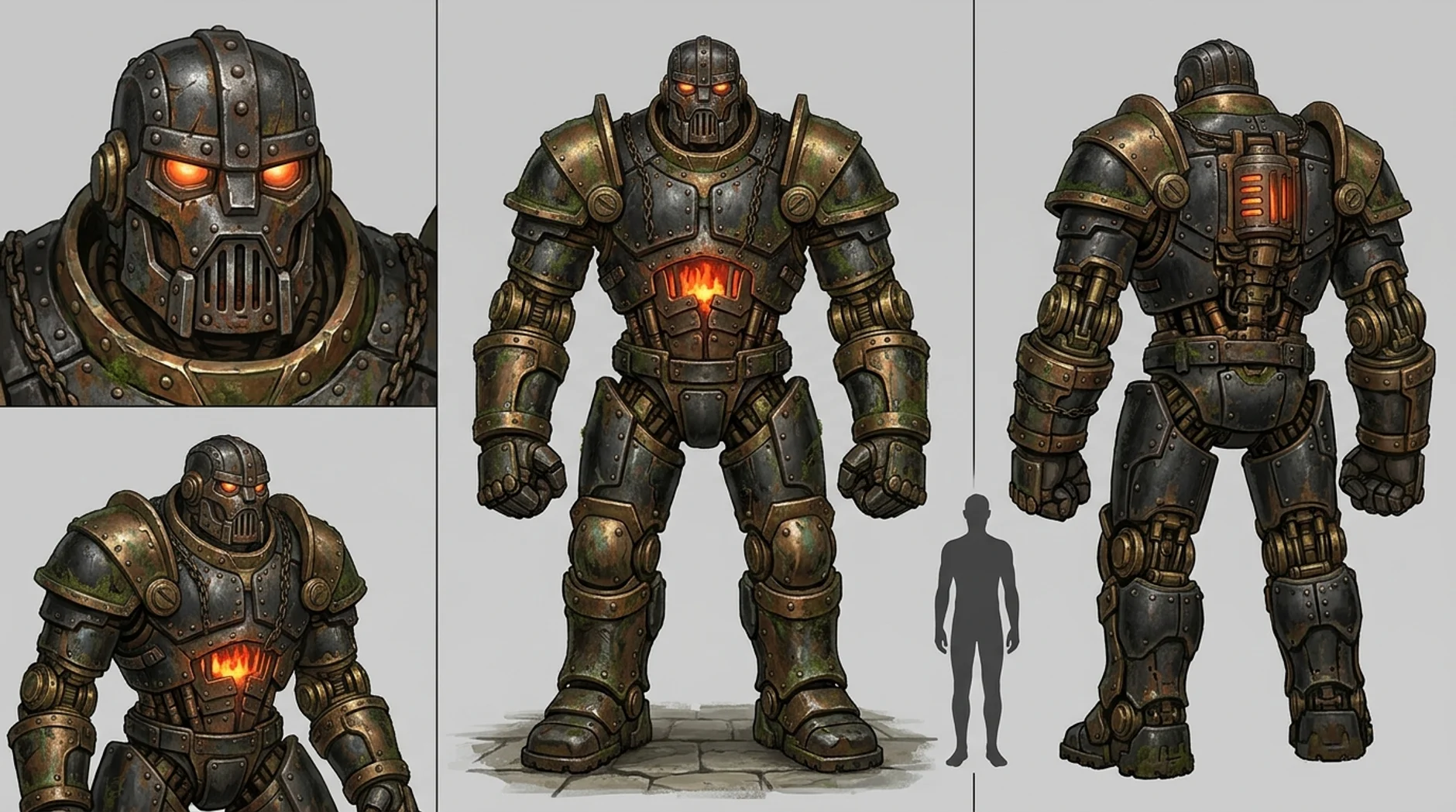
Scale is the hardest thing to communicate to an image model, because nothing in a framed picture has an absolute size. The fix is in the prompt: give it a reference object. Asking for a human silhouette beside the construct forces the model to resolve the relationship rather than guess it.
Material specificity does the rest. Riveted blackened iron, weathered bronze, moss in the seams. Those are three different surface behaviours, and naming them separately stops the whole figure collapsing into one grey texture.
Prompt:
Character reference sheet for Ferrum, a towering humanoid construct built from riveted blackened iron and weathered bronze plating, roughly four metres tall. Exposed brass gearwork at the joints, a furnace glow visible between the chest plates, moss and rust gathered in the seams. Heavy, deliberate stance with fists at its sides. Include a small human silhouette beside it for scale. Include a front-facing face close-up, a full front body view, and a full back body view arranged together in one frame as a single clean character design grid, like a model reference sheet. Plain neutral light grey seamless studio background. Flat even studio lighting. 16:9 aspect ratio. Absolutely no text, logos or watermarks.To control scale, name a reference object in the frame. Without one, the model has no way to know whether four metres means anything.
8. The Companion Creature: Pip, The Ember Fox
Companion creatures are an appeal problem, not a detail problem. Oversized eyes, rounded proportions and a clear silhouette do more than any amount of ornamentation. The six legs are there to make it read as non-Earth without making it unreadable.
Asking for two poses, alert and mid-leap, is the important instruction. A creature that only exists in one attitude will not survive contact with a storyboard.
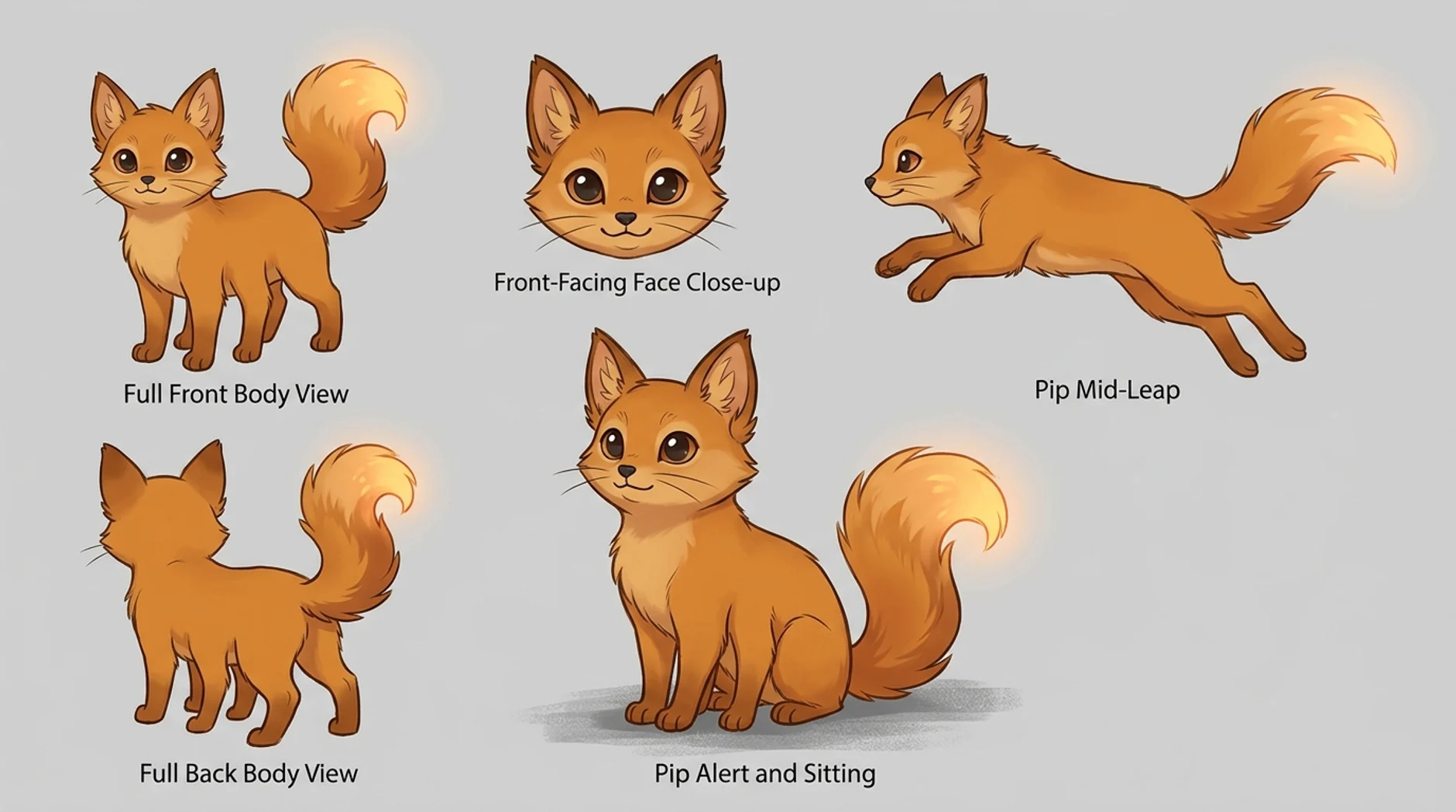
Prompt:
Character reference sheet for Pip, a small six-legged fox-like creature the size of a house cat, with warm amber fur, oversized expressive dark eyes, tufted ears, and a plume tail that glows faintly at the tip like a banked ember. Rounded appealing proportions. Show it alert and sitting, plus one pose mid-leap. Include a front-facing face close-up, a full front body view, and a full back body view arranged together in one frame as a single clean character design grid, like a model reference sheet. Plain neutral light grey seamless studio background. Flat even studio lighting. 16:9 aspect ratio. Absolutely no text, logos or watermarks.Ask for two poses in the same sheet. A creature that only exists in one attitude cannot be storyboarded.
9. The Wasteland Survivor: Mara, The Scavenger
Wear is a character trait. Everything in this prompt is described in terms of what happened to it: patched, salvaged, mismatched, sand-scoured, repaired. That is a different instruction from asking for a post-apocalyptic survivor, which will hand you a costume rather than a history.
Faces respond to the same approach. Sun-darkened skin and deep lines around the eyes tell the model about a life, not a look.
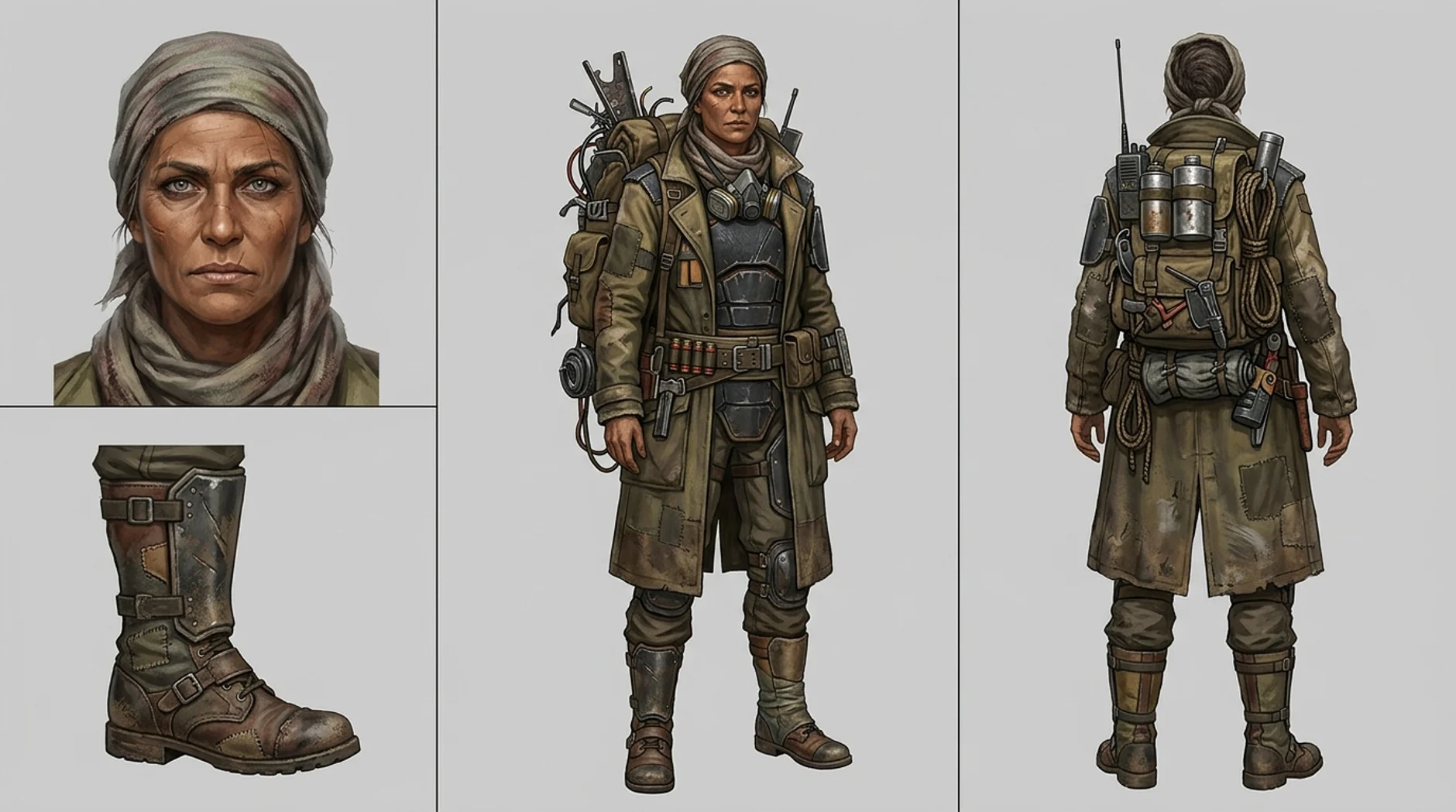
Prompt:
Character reference sheet for Mara, a weathered female survivor in her forties, sun-darkened skin, deep lines around the eyes, hair wrapped in a faded scarf. She wears layered improvised gear: a patched canvas coat over salvaged body armour, mismatched boots, a respirator slung at the neck, and a pack bristling with scavenged parts. Every surface worn, sand-scoured and repaired. Include a front-facing face close-up, a full front body view, and a full back body view arranged together in one frame as a single clean character design grid, like a model reference sheet. Plain neutral light grey seamless studio background. Flat even studio lighting. 16:9 aspect ratio. Absolutely no text, logos or watermarks.Describe wear as history, what happened to the object, not as a style. Patched and sand-scoured outperform post-apocalyptic every time.
10. The Street Samurai: Kenji, Chrome and Bone
Cyberpunk fails when the tech is decoration. This prompt integrates it: half the face plated, a single optic, visible cabling running into the forearms. The augmentation is structural rather than bolted on, which is the difference between a character and a costume.
The restricted palette matters as much as the hardware. Black, gunmetal and cyan, and nothing else, keeps a design that could easily become noise legible at a glance.
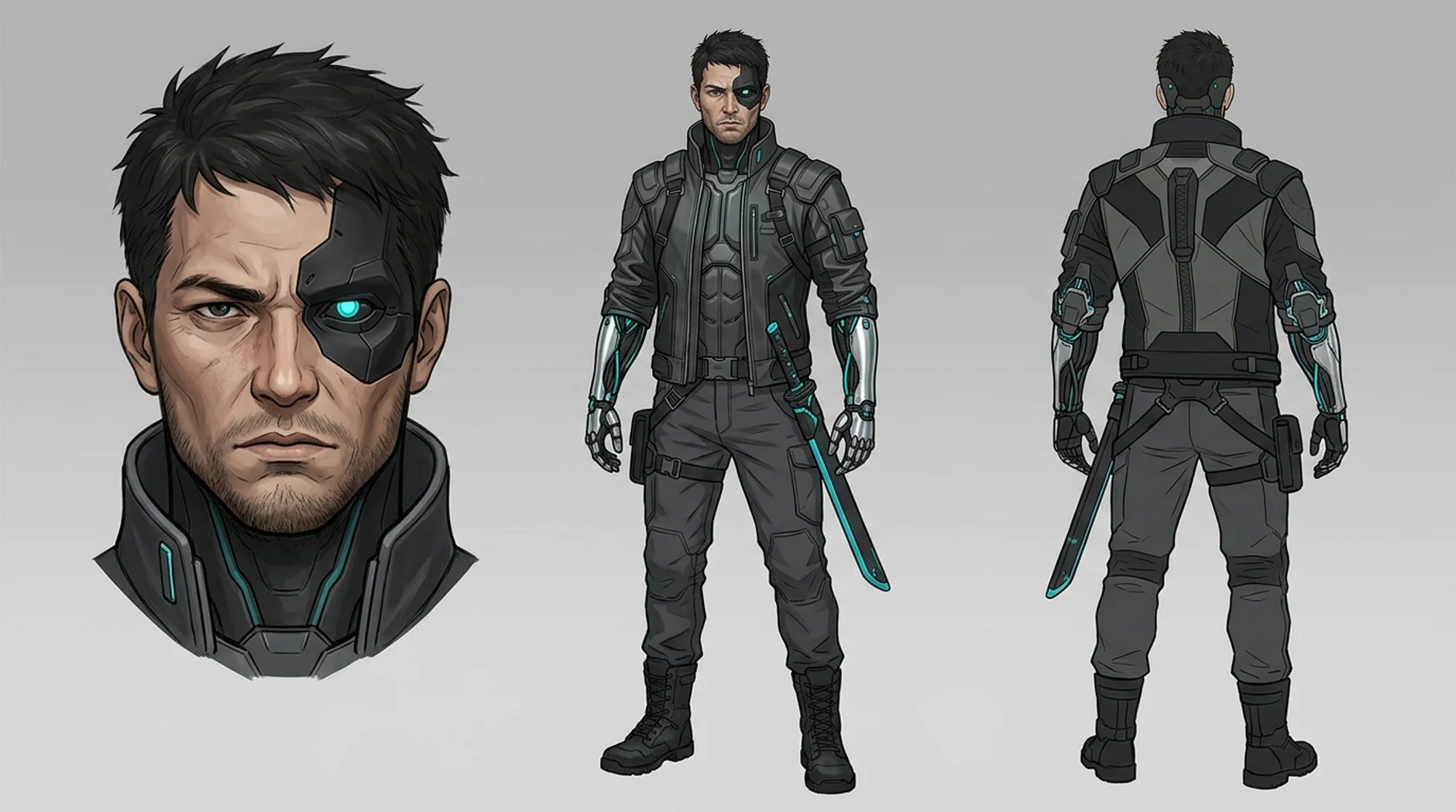
Prompt:
Character reference sheet for Kenji, a lean male street samurai in his thirties, half his face overlaid with a matte black cybernetic plate and a single glowing cyan optic. Chrome forearm prosthetics with visible cabling, a fitted technical jacket over an armoured underlayer, a monomolecular blade sheathed at the hip. Cool restrained palette of black, gunmetal and cyan. Include a front-facing face close-up, a full front body view, and a full back body view arranged together in one frame as a single clean character design grid, like a model reference sheet. Plain neutral light grey seamless studio background. Flat even studio lighting. 16:9 aspect ratio. Absolutely no text, logos or watermarks.Integrate the technology into the anatomy and restrict the palette. Cyberpunk goes wrong when the tech is jewellery and the colours are a fireworks display.
11. The Ethereal Spirit: Vesper, The Tidecaller
Translucency is where most character prompts break down, because a model asked for a ghost will usually give you a person at reduced opacity. Describing what is visible inside the form, suspended sand and drifting fish, forces genuine volume instead of a transparency slider.
The instruction that edges soften and lose definition toward the feet is deliberate. Telling the model where a form should stop resolving is as useful as telling it where to be sharp.
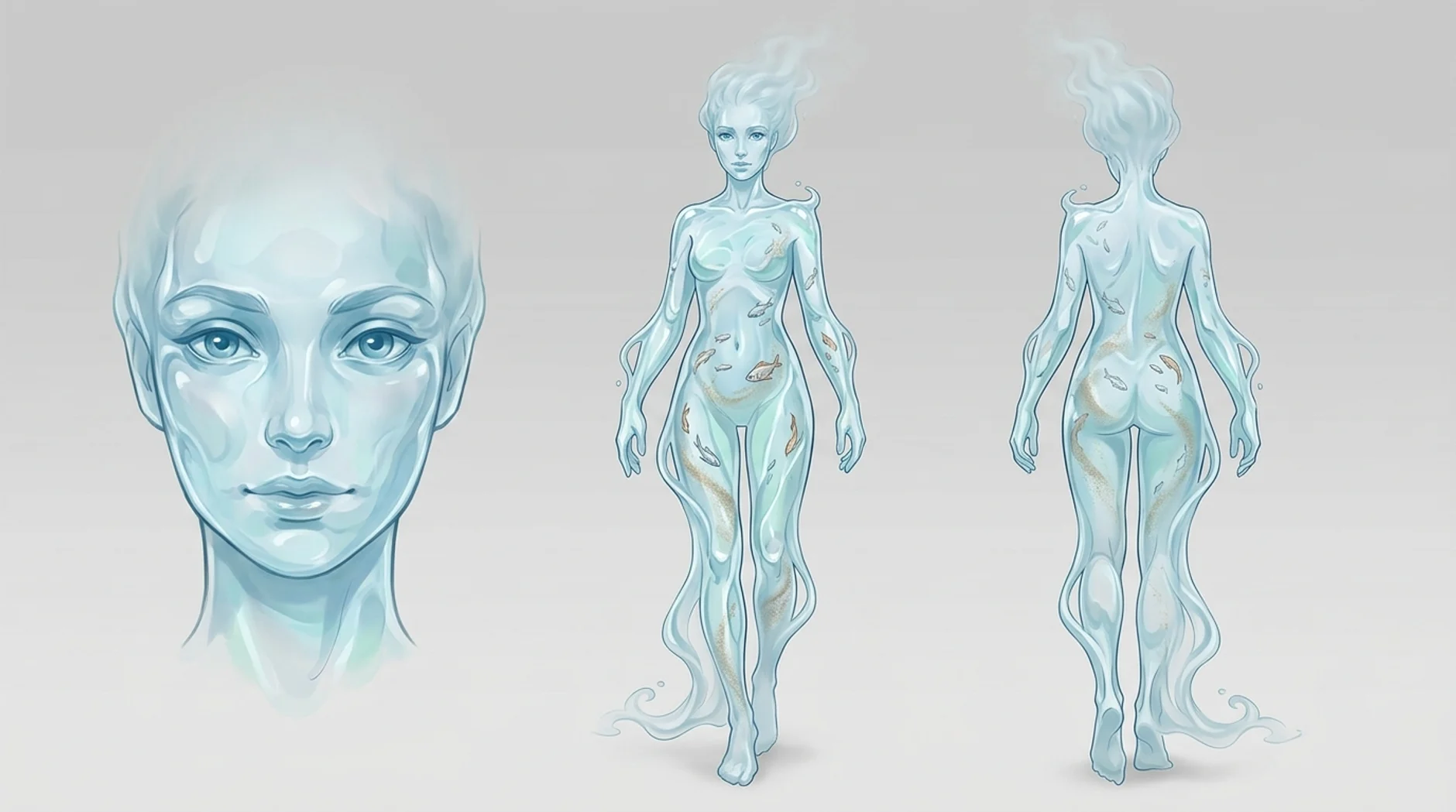
Prompt:
Character reference sheet for Vesper, a translucent water spirit in a loosely humanoid female form, roughly two metres tall. Her body is flowing semi-transparent water with pale blue and seafoam refraction, suspended sand and small fish visible drifting inside her. Hair dissolves upward into mist. Edges soften and lose definition toward the feet. Include a front-facing face close-up, a full front body view, and a full back body view arranged together in one frame as a single clean character design grid, like a model reference sheet. Plain neutral light grey seamless studio background. Flat even studio lighting. 16:9 aspect ratio. Absolutely no text, logos or watermarks.For anything translucent, describe what is visible inside the form. That produces volume; asking for transparency produces a faded person.
Lyra, “an elderly female chronomancer,” immediately suggests a character of immense wisdom and experience, specifically tied to the manipulation of time. Her “wise, serene features” and “long flowing white hair streaked with silver” reinforce this image of age and power. The “eyes that glow with faint ethereal blue light” are a crucial visual cue, indicating her magical abilities and perhaps a connection to a different plane of existence.
Her attire, “layered robes of deep indigo and celestial blue velvet, embroidered with intricate golden clockwork patterns and ancient runic symbols,” is rich with detail, reflecting her specialization in chronomancy and her connection to ancient lore. The “gnarled wooden staff topped with a rotating crystal orb that pulses with soft light” is a classic magical accoutrement, but with the specific detail of a “rotating crystal orb” further emphasizing her control over time.
When crafting your own mage character prompts, consider how their attire, accessories, and physical features can visually communicate their magical discipline, their power level, and their personality.
Beyond the Prompts: Iteration and Refinement in Character Creation
While these five character design prompts provide an excellent starting point, the true power of AI in character creation lies in iteration and refinement. Generating an initial concept is just the first step. The next crucial phase involves analyzing the output, identifying areas for improvement, and then adjusting your prompts to steer the AI closer to your ultimate vision.
This iterative process is what distinguishes casual AI users from professional artists who leverage these tools for production-ready assets.
Consider the initial output from one of these prompts. Does the armor look too heavy or too light? Is the villain sufficiently menacing, or does the creature lack a certain ferocity? These are questions that demand a critical eye and a willingness to re-engage with the prompt engineering process. Small tweaks in descriptive adjectives, changes in material specifications, or even adjustments to the implied lighting can dramatically alter the outcome.
For instance, changing “grizzled” to “battle-scarred” might evoke a different kind of heroism, or “subtle glowing” to “intense pulsating” could escalate a villain’s threat level.
The art of refinement also involves understanding the limitations and biases of the AI model itself. Some models might lean towards certain aesthetic styles or interpretations. By running multiple variations of your initial character prompts, you can gain a better understanding of the AI’s “vocabulary” and learn how to phrase your requests more effectively.
This insight allows you to anticipate potential outcomes and adjust your language proactively, minimizing the need for extensive post-generation editing.
Moreover, the reference sheets generated by these prompts are not ends in themselves, but rather powerful starting points. They provide a solid visual foundation for 3D modelers, animators, and illustrators to build upon. Artists can use these sheets as direct guides for sculpting, texturing, rigging, and painting, ensuring that the core design intent remains consistent throughout the production pipeline.
This consistency is invaluable in maintaining a cohesive visual style across an entire project, whether it’s a video game with hundreds of characters or a film with a complex cast.
Optimizing Your Workflow with Advanced Character Prompts
Integrating sophisticated character prompts into your daily workflow can dramatically enhance productivity and creative output. Beyond simply generating initial concepts, these prompts can be adapted for various stages of the design process, from exploring costume variations to generating specific emotional expressions or action poses. The key is to think of prompt engineering as a dynamic, evolving skill rather than a static task.
One effective strategy is to create a library of prompt fragments. These are reusable descriptive elements for specific materials, textures, lighting conditions, or stylistic modifiers. For example, you might have a fragment for “worn leather texture,” “cybernetic implants,” or “steampunk aesthetic.” By combining these fragments, you can rapidly construct new, complex character prompts without starting from scratch each time.
This modular approach not only saves time but also ensures consistency in how certain elements are described and interpreted by the AI.
Another advanced technique involves utilizing negative prompts. These instructions tell the AI what not to include in the image, helping to refine the output by eliminating unwanted elements or stylistic tendencies.
For example, if your character consistently appears too cartoonish, you might add a negative prompt like “no cartoon, no anime, realistic.” This level of control allows for a more precise sculpting of the AI’s output, pushing it closer to a specific artistic vision.
According to a recent TechCrunch article from earlier this year, advanced prompt engineering techniques, including negative prompts, are becoming standard practice for professional AI artists seeking nuanced control over generative models. TechCrunch highlighted the growing sophistication in AI art creation.
For teams, establishing a shared vocabulary for character descriptions and prompt structures is crucial. This ensures that all artists, regardless of their individual prompt engineering experience, can achieve consistent results when generating assets for the same project. This standardization is especially important for large-scale productions where multiple artists might be contributing to character design.
Tools like AI Render Pro facilitate this by providing a consistent framework for interpretation, but the human element of shared understanding remains paramount.
The Future Landscape of Character Design and AI
Looking ahead, the synergy between character design and artificial intelligence is only set to deepen. We are already seeing advancements in AI models that can generate 3D assets directly from 2D prompts, or even animate characters based on textual descriptions. The role of the artist is evolving from solely manual creation to increasingly becoming a director and curator of AI-generated content.
This shift requires a new skill set centered around critical thinking, aesthetic judgment, and, crucially, sophisticated prompt engineering.
The ability to craft precise and effective character prompts will become an even more valuable skill. As AI models become more capable, the nuance in prompt design will allow for even more intricate and specific outputs, blurring the lines between concept art and final asset production. Imagine generating a fully rigged 3D character model, complete with textures and a basic animation cycle, all from a single, highly detailed prompt. This is not far-fetched for the near future.
Furthermore, AI is likely to play a significant role in ethical character design. By analyzing vast datasets, AI tools could help identify and mitigate biases in character representations, ensuring greater diversity and inclusivity in visual media. This proactive approach to design, guided by intelligent systems, could lead to more representative and thoughtfully crafted characters across all platforms.
Organizations like Autodesk, a leader in 3D design software, are continuously exploring how AI can enhance their tools, pushing the boundaries of what’s possible in digital creation.
Ultimately, the future of character design with AI is one of collaboration. Artists will remain at the heart of the creative process, their vision and aesthetic judgment guiding the powerful generative engines. The tools will become more intuitive, more powerful, and more integrated, but the spark of imagination and the understanding of narrative and emotional resonance will always be human.
Mastering the language of AI through expert character prompts is not just about staying relevant; it’s about leading the charge into this exciting new era of creative possibilities. The potential for innovation is boundless, and those who embrace these tools effectively will shape the visual stories of tomorrow.
The Real Cost of AI Filmmaking Is Not the Prompts
Every frame in this article came from a written prompt, and the difference between a workable result and a usable one is specificity. This is what a production-ready prompt looks like in practice, with the frame it produced:
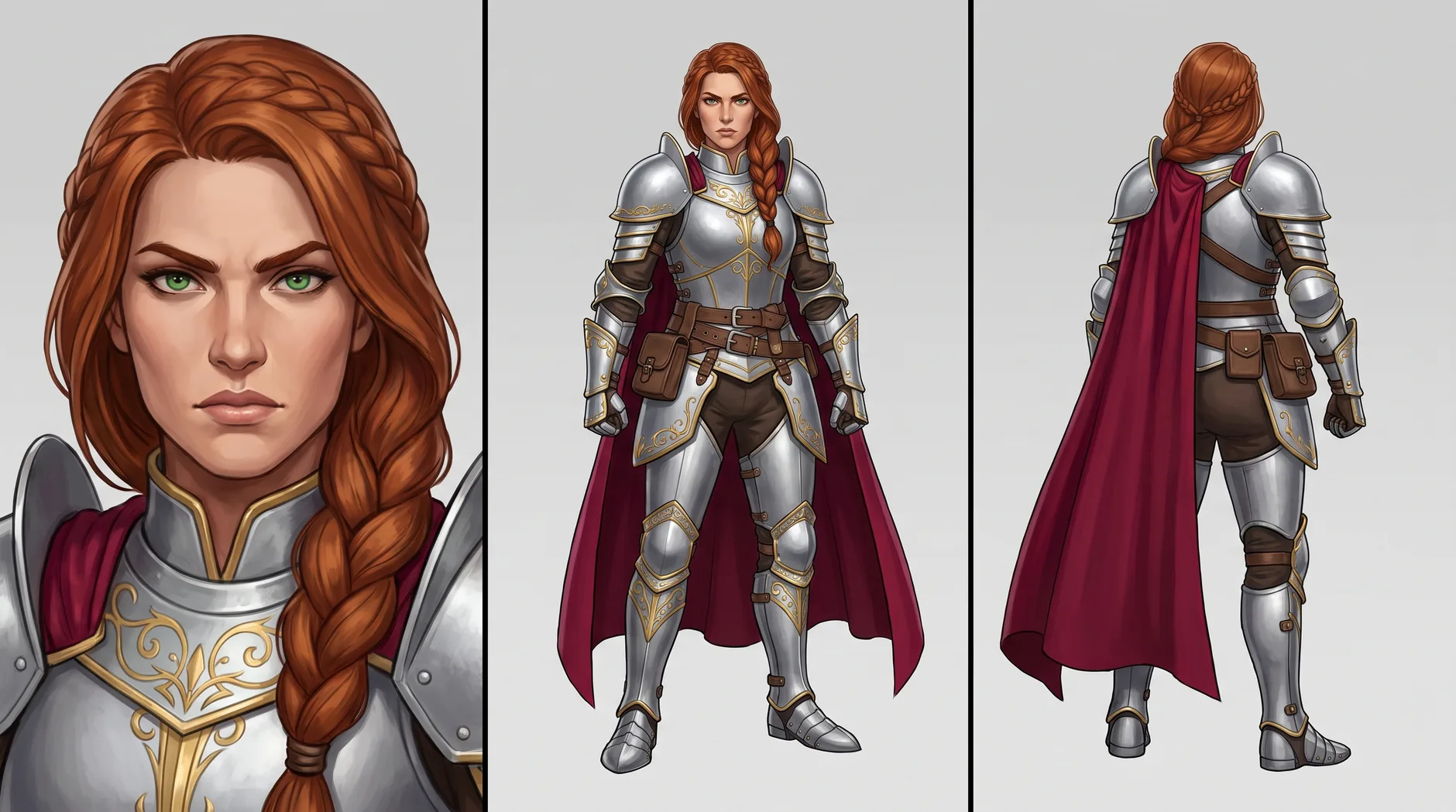
Character reference sheet for Elara, a valiant female knight, approximately 30 years old, with strong, determined features, long braided auburn hair, and piercing green eyes. She wears intricately forged silver plate armor with gold filigree accents, a flowing crimson cape, and a practical leather utility belt with pouches. Her stance is confident and ready for action. Include a front-facing face close-up, a full front body view, and a full back body view arranged together in one frame as a single clean character design grid, like a model reference sheet. Plain neutral light grey seamless studio background. Flat even studio lighting. 16:9 aspect ratio. Absolutely no text, logos or watermarks.The part that actually drains a budget is not the prompt writing though. It is the credit system. Most AI platforms charge a subscription, then sell credits on top of it, with a markup on every render and a counter that resets each month whether you shipped anything or not. Generate, upscale, regenerate a few takes, and a single short film chews through pricing tiers fast.
AI Render Pro Studio is the pipeline I built to cut that out. One browser workspace for the whole run: script breakdown, storyboards, image generation, more than 30 video models including Seedance 2.5 with 30-second native-audio takes, Seedance 2.0 in native 4K and Kling O3, plus retouch, upscaling past 7K and an audio studio. It costs $19 a month flat, and you plug in your own API keys, so every render is billed by the provider at cost. No markup, no credit packs, no expiring tokens. On a real project that difference is not a rounding error, it is the budget.
Try AI Render Pro Studio, $19/month →
Every AI image in this article was generated with AI Render Pro, the prompting engine I built for filmmakers and creatives. Read the full breakdown here.
Frequently Asked Questions
What are effective character design prompts for AI?
Effective character design prompts for AI are highly specific and detailed, covering the character’s archetype, physical attributes, clothing, style, and desired presentation format. They should clearly define visual elements like background, lighting, and composition to guide the AI towards a precise output, such as a multi-view reference sheet.
How can I achieve consistency with character prompts?
Achieving consistency requires meticulous detail in your prompts, specifying exact colors, textures, and recurring motifs. For character reference sheets, explicitly requesting “a single clean character design grid” with specific views (face, front, back) and consistent lighting is crucial. Iteration and the use of negative prompts also help refine consistency.
Why use a reference sheet format for AI character design?
A reference sheet format is invaluable for character design because it provides a comprehensive, consistent visual guide from multiple angles. This format is essential for 3D modelers, animators, and illustrators to ensure accuracy and maintain the character’s integrity across different assets and scenes in a production pipeline.
What are the benefits of detailed character prompts?
Detailed character prompts offer several benefits: they reduce ambiguity for the AI, leading to more precise and usable outputs; they accelerate the concept art phase by minimizing iterations; and they ensure that the generated assets align closely with the artist’s original vision, saving time and resources in later production stages.
Which tools are best for generating AI character prompts?
Tools like AI Render Pro are specifically designed to excel at generating detailed character designs from comprehensive prompts. These platforms often provide advanced controls for style, composition, and consistency, making them ideal for artists who require high-quality, production-ready character reference sheets.
Discover more from Olivier Hero Dressen Blog: Filmmaking & Creative Tech
Subscribe to get the latest posts sent to your email.
Work with Olivier
Director | CD | DP & Photographer
Specializing in commercials, music videos, AI-driven filmmaking, and cinematic storytelling for brands and production companies.
🌍 Shanghai · Paris · Los Angeles · Dubai
🎬 View Portfolio & Get in Touch